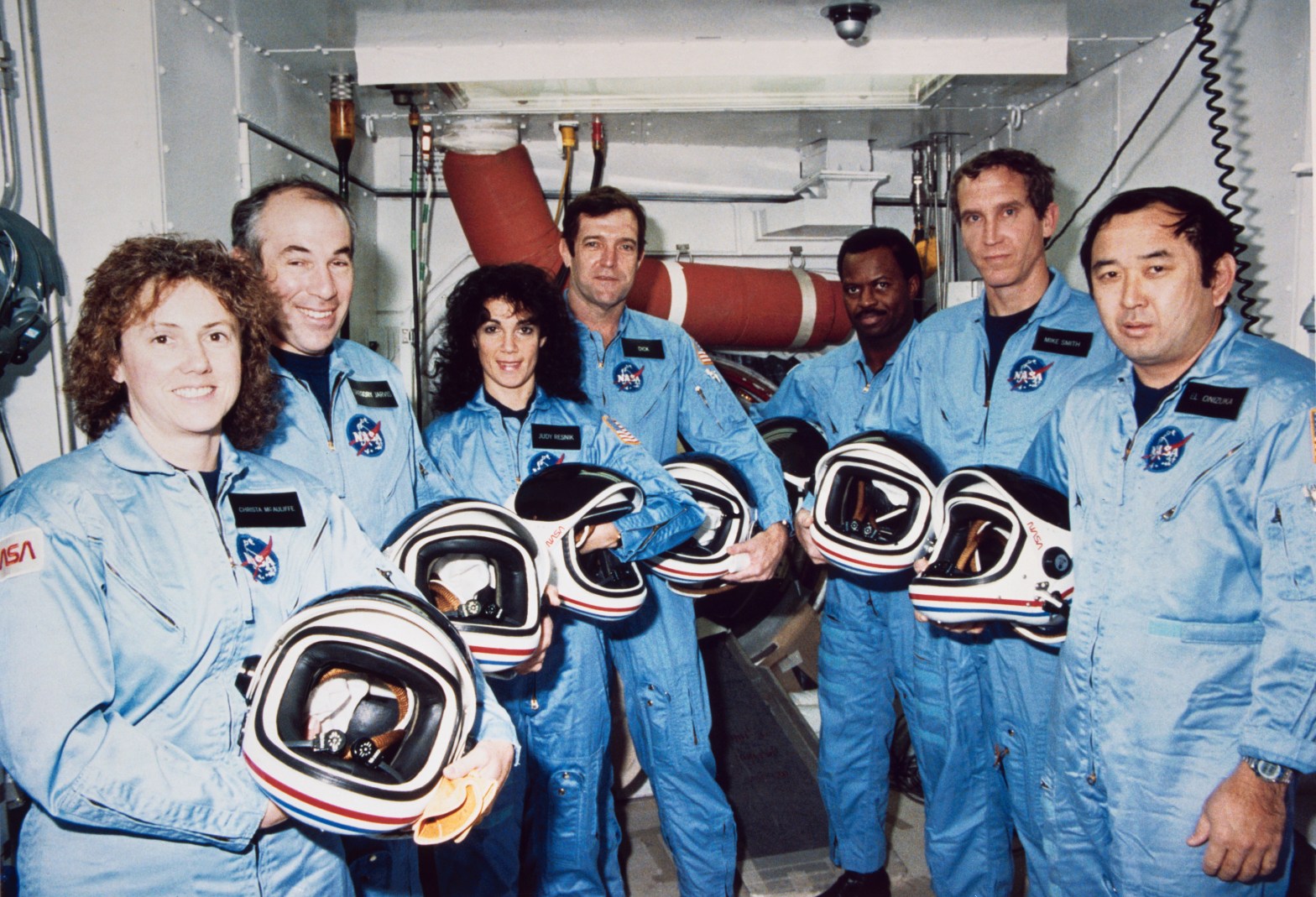

It was unusually cold on the morning of January 28, 1986, and orbiter Challenger had spent the overnight on the launch pad at the Kennedy Space Center, Florida. The first thing the engineers noticed that morning was ice crystals around the ship and the equipment. That was not a good sign.
The ship was (supposedly) ready for the 25th mission of the STS program. The purpose of the flight was to deploy a communication satellite and also to study Halley’s comet. At 11:39 EST, the orbiter took off, carrying a crew of seven, and among them one civilian, Christa McAuliffe, a school teacher from Concord, New Hampshire. After 73 seconds on its flight, a malfunction in one of the solid rocket boosters caused an explosion, disintegrating the whole craft. None of the crew members survived.
A Teacher among the astronauts

In 1985 NASA created a project called Teacher in Space, hoping that sending a teacher into orbit would increase public interest in the program, and also reassure the reliability of space flight at a time when the agency was under continuous pressure to keep its financial support. President Reagan said it would also remind Americans of the important role that teachers and education serve in their country.
McAuliffe was chosen among 11,000 applicants; she went through proper training and received the title of Payload Specialist. She was 37 years old when boarded the Challenger on that fateful morning.
The “O’ring” problem.
The two Solid Rocket Booster provided most of the thrust necessary to send the shuttle into orbit. Each one of them is a massive piece of equipment, with 45.46 m (149.16 ft) in height and 3.71 m (12.17 ft) in diameter.

The boosters were built in four segments at Morton Thiokol Company and then shipped to Cape Canaveral; once there, NASA would put them together and attach them to ship. Each segment is sealed with two O-rings, one primary and one backup, and since the beginning of the program, those O’rings proved problematic. Under extreme pressure, the seals would extrude from their seats rather than compressed. The Thiokol engineers warned NASA that the O’rings and their seats needed improvement but the agency always judged the matter was within acceptable safety parameters.
Many problems plagued the orbiters up to this point in the program’s development and perhaps, the O’ring issue was one of the easiest to be fixed.
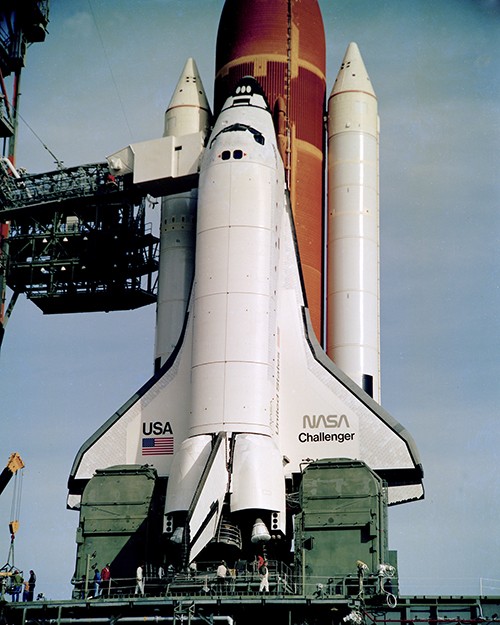
The morning of the Challenger launch was bitter cold, it had reached -8°C (18° F) overnight, and around 9 o’clock it was -3°C (26° F), a record low for a Space Shuttle launch. The Thiokol engineers expressed their concern that the cold weather could have harden the already problematic rubber seals, diminishing even further their capacity. Thiokol was in favor to postpone the launch, but NASA insisted to go on. After a brief phone call between the two parties, the engineers changed their opinion and gave NASA the green light for launch.
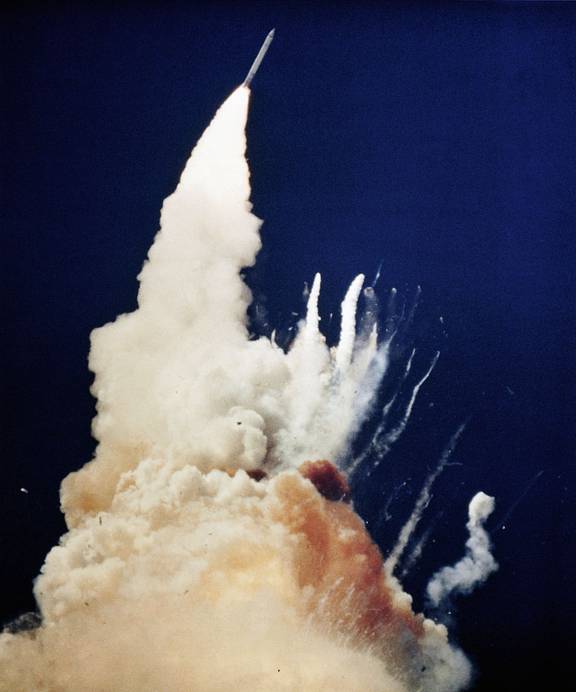
As predicted, at the takeoff, one of the O’rings failed, on the right side booster, causing hot gas and flames to travel through the joint section. After 73 seconds into the flight, the ship exploded.
A televised catastrophe
The decision to take a civilian into space sparked a higher-than-usual interest among the population and the media around the world. The disaster was seen live by millions of people. I saw the video of the explosion later that day, at the evening news, and even after 37 years, I still remember the gut-wrenching feeling of it and how hard was accepting that a NASA’s space ship had been lost.
President Ronald Regan had been scheduled to give his 1986 State of the Union Address on January 28, 1986, the evening of the disaster. Some people believe that NASA was under pressure not to postpone the mission because Regan wanted to talk about it in his speech. Needless to say, the President canceled his discourse and he addressed the nation about the disaster instead.
The aftermath

NASA spent months recovering pieces of the wreckage from the ocean floor and also human remains of the seven astronauts. A series of investigations and safety commissions were launched. The government put the Space Shuttle program on ice for 32 months.
The result of the investigation just made official something NASA and Thiokol knew all along, the faulty O’rings were the culprit of the explosion.
The agency finally allowed the engineers to address the issue; the joints and the gaskets on the booster were redesigned and greatly improved.
The world always regarded NASA as the zenith of engineering, we always admired them as the most capable and efficient professionals on the planet. For me, and I believe for many others around the world, it is hard to believe that NASA allowed money and politics to interfere in the agency’s affairs.

The picture above shows the Space Shuttle Challenger Memorial, right after a wreath laying ceremony that was part of NASA’s Day of Remembrance, Thursday, Jan. 26, 2012, at Arlington National Cemetery.
It was tragic that seven people had to die in order to get such a simple issue fixed. In the years that followed the accident there was lot of blaming going around but no criminal charges were ever filed.
As one would expect, the Teacher in Space program was canceled after the disaster.
 The Classic Machines