

The orbiter Enterprise was the very first Shuttle built for the program, but the ship wasn’t even fitted with engines; it was exclusively used for gliding tests and it never left Earth’s atmosphere. It was the second ship, Columbia, that had the honor of being the first orbiter to reach space. In so many ways Columbia was the banner of the Space Shuttle Program.

On January 16, 2003, Columbia left Earth on its 28th mission, carrying a crew of seven. Although NASA was deeply involved in the construction of the International Space Station, Columbia’s last mission, STS-107, was purely for scientific research. The flight was originally scheduled to launch on January 11, 2001, but it was delayed thirteen times. Even after 20 years after its first flight, NASA was still fighting multiple problems that plagued the program.

With all systems on the green, Columbia ignited all its engines and launched at 10:39 a.m. Once again, what seemed to be a perfect lift-off, was, in fact, a tragic one. At 81.9 seconds after the launch, a piece of foam, measuring approximately 21 to 27 inches (53 to 69 cm) long and 12 to 18 inches (30 to 46 cm) wide, broke off from the left bipod on the external fuel tank, striking the panels on Columbia‘s left wing like a cannonball, at a relative velocity of 573 mph (922 km/h), severely damaging the carbon thermal shield on the edge of the wing.
The thermal shield problem
The ceramic tiles used to protect the ships against the scorching heat during the reentry proved to be a headache from day one. There are reports of missing titles even during the gliding tests, in the late 1970s. Although the thermal protection around the orbiters received several improvements throughout the program, by the early 2000s it was still very fragile against the impact of debris.
The solid rocket boosters and the external fuel tank also received a thermal shield but with a different purpose. They were covered with insulating foam, meant to keep the liquid hydrogen (LH2), stored at −253 °C (−423 °F), and a smaller tank for liquid oxygen (LOX), held at −183 °C (−297 °F). The insulation also prevented ice from forming on the tank’s exterior.

This foam performs quite well as a thermal shield, but it can be extremely troublesome to endure the hardships of ascending. Speed and vibration cause the material to crack and break apart. Foam strikes occurred regularly during Space Shuttle launches; of the 79 missions with available imagery during launch, foam strikes occurred on 65 of them, resulting in damages to the ship’s thermal shields, from minor to near catastrophic, as was the case of Atlantis in 1988. Once again, the years have passed and NASA didn’t take a more effective approach to fix the problem.
The doomed mission

It was only on the second day after the launch that NASA, during a routine review of videos of the lift-off, noticed the debris strike. None of the cameras that recorded the launch had a clear view of the incident, leaving the group unable to determine the level of damage sustained by the orbiter.
Boeing engineers (1) replicated the incident on modeling computers and they concluded that the damage to the thermal shield was severe enough to compromise the integrity of the wing during reentry. On the other hand, NASA downplayed as much as possible the severity of the situation, after all, foam strikes were a common occurrence and so far, they had managed to bring the crew safely back home.
The engineers and a few NASA officials proposed a request with the Department of Defense to reroute its orbital spy cameras to take a closer look at the damaged wing. The idea really got some traction when the DoD said it would gladly do whatever was necessary to take those pics. However, NASA Mission Management Team Leader Linda Ham declined the offer, saying the procedure would interfere with the ongoing science operations.
The crew spent their 16 days in space conducting some 80 experiments before preparing to return home, on the morning of Feb. 1, 2003.
Jason Hutchinson/AP
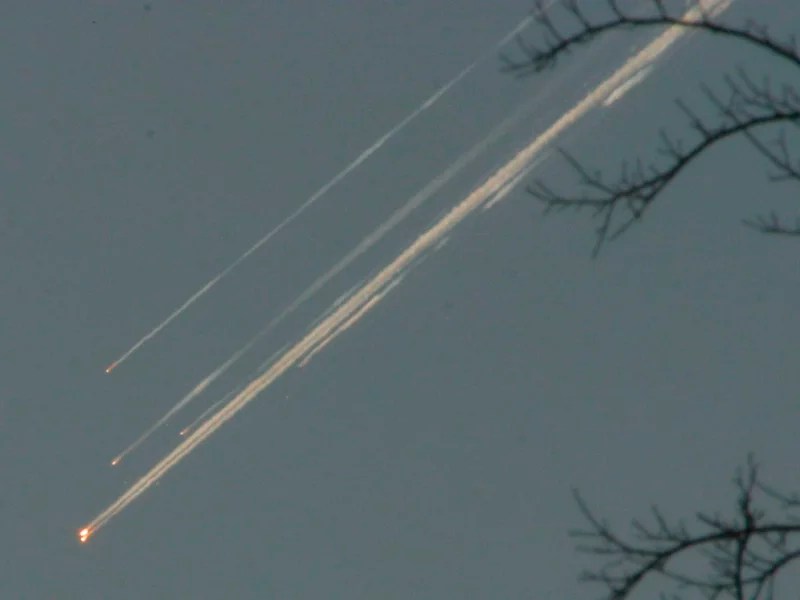
During the reentry, as predicted, the damaged thermal shield allowed hot gases to penetrate the left wing, melting its internal structure. The wing started to disintegrate and after a few minutes, it completely broke off, causing the shuttle to spin violently and eventually break apart over northeast Texas, near Dallas. All seven astronauts perished in the accident.
In the chaotic minutes that preceded the disaster, NASA was receiving confusing data from the sensors placed around the ship, and after that, they lost communications with the crew. Mission control was still scrambling for answers when they received a phone call saying that a television network was showing a video of the shuttle breaking up in the sky.
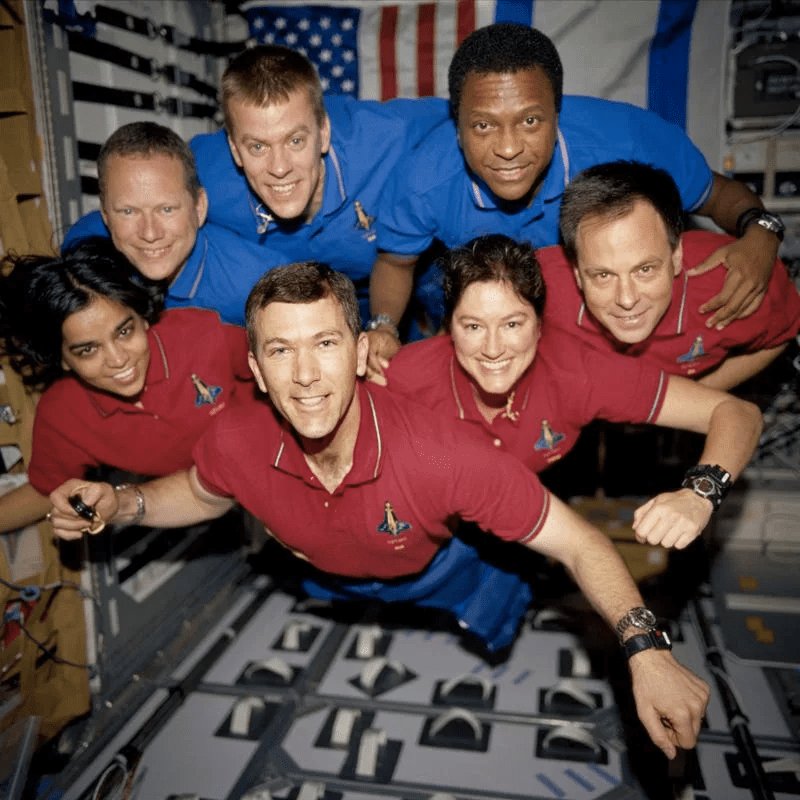
This amazing shot of the STS-107 crew was on a roll of unprocessed film that was later recovered during searches of fallen Columbia debris. From left (bottom row) Kalpana Chawla, the mission commander Rick Husband, Laurel Clark, and from the Israeli Space Agency Ilan Ramon. From left (top row) David Brown, William McCool, and Michael Anderson.
The investigation board reporter

NASA recovered 82,000 pieces of debris from the disaster. In total 84,800 pounds or 38 percent of the dry weight of Columbia. Among the recovered materials were the remains of the seven astronauts, which were identified with DNA.
In the week that followed the disaster, The Columbia Accident Investigation Board released a multi-volume report on how the orbiter was lost and what led to it.
Besides the physical cause, CAIB produced a damning assessment of the culture at NASA that had led to the foam problem and other safety issues being minimized over the years.
“Cultural traits and organizational practices detrimental to safety were allowed to develop. Reliance on past success as a substitute for sound engineering practices and organizational barriers that prevented effective communication of critical safety information”
“The shuttle is now an aging system but still developmental in character. It is in the nation’s interest to replace the shuttle as soon as possible,” the report stated.

NASA kept the Space Shuttle program going until the completion of the International Space Station. The ISS was also viewed as a safe haven for astronauts to shelter in case of another malfunction.
The space shuttle program was retired in July 2011 after 135 missions, including the catastrophic failures of Challenger in 1986 and Columbia in 2003.
Conclusion

It is not easy to criticize a program that is so emblematic. For more than 30 years the Space Shuttle was a matter of pride not only for Americans but for mankind. For me, it is impossible to look back in time and not picture it; if I bring the 1980s back in my memory, the first flight of Columbia will be there, side by side with Tears For Fears and the fall of the Berlin Wall.
But a cold analysis of the number will show a somber reality: a total of five orbiters were initially built: Enterprise, Columbia, Challenger, Discovery, and Atlantis. A fifth operational orbiter, Endeavour, was built in 1991 to replace Challenger, and when we consider that 2 ships were tragically lost, that’s a 40% vehicular failure rate and a flight failure of 1.5%. This would have grounded any other vehicle permanently.

Each Shuttle was designed for a life span of ten years. Keeping the ships flying for twenty years past the expiration date stifled creativity and innovation. The end of the program marks the end of the reusable spaceship dream, a sci-fi concept that engineers and designers have nourished since the 1950s.
In a very ironic turn of events, NASA brokered an agreement with the Russians to use the Soyuz spacecraft to ferry American astronauts to orbit until the private Space X rocket program became operational.
(1) – Boeing became the company responsible for providing engineering assistance for the program after the acquisition of Rockwell International, in 1996.
 The Classic Machines