
Car guys can be a very opinionated bunch indeed, some of them will worship one brand and despise all the others, and some of them will prefer a certain category of cars and make fun of the others. But there is one thing that seems to bring all of us together, we all have a soft spot for station wagons (or Estate, as they are known in Europe and the UK).
Is it easy to explain this unconstitutional love? I don’t know, maybe because since the wagons are based on regular cars, it doesn’t take much to make them perform like a sports sedan and you still have plenty of room for all your family’s junk. On top of that, a tastefully modified wagon can look even more badass than its sibling sedan (ok, the last statement is open for some debate).
The sporty wagon.
Unfortunately here in North America, consumers have replaced the station wagon with SUVs, but in Europe, the segment is very much alive. Brands like Volvo, BMW, Audi, and Mercedes-Benz have been exploring the idea of high-performance station wagon, for a while and some of the results are nothing short of stunning. A couple of weeks ago I drove by a brand new Audi RS6 Avant and WOW, that thing does look like a race car.
Well, since we are bringing the the words station wagon and race car into the same sentence, lets talk about… Volvo.
It will be hard to find another automaker more deeply attached to station wagons, than Volvo. The company built its image upon reliability and thousands of families bought those brick-shaped wagons not for the looks but mainly because they felt safe driving around in a car that was built like a tank.
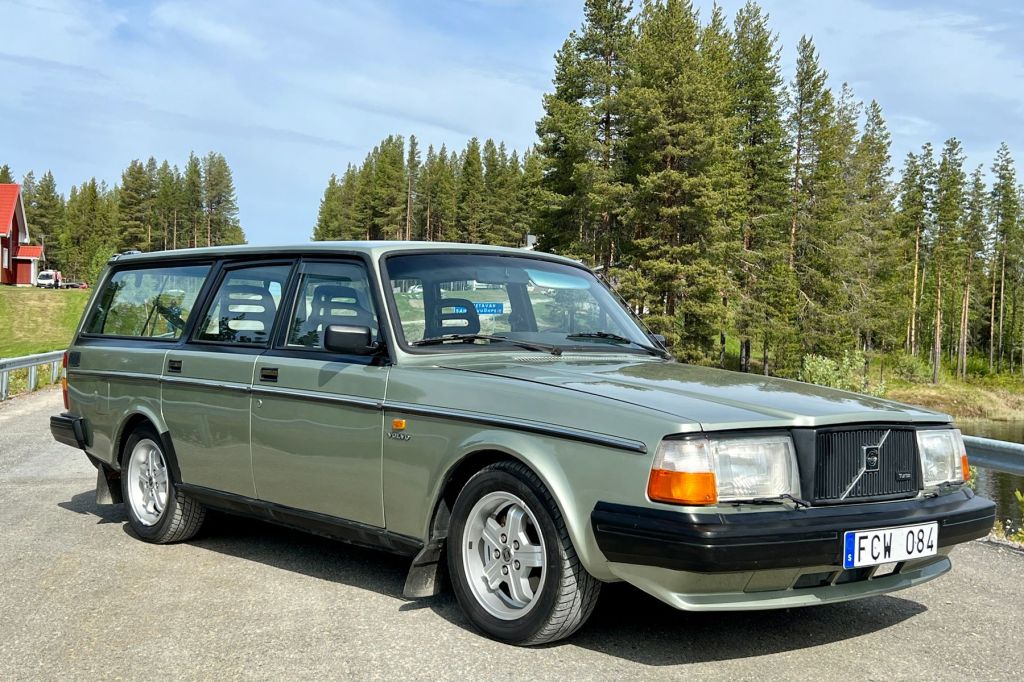
Volvo started building station wagons in the 1950s but it was only in the 1980s that the 245 model won hearts and minds in North America. In 1981, they released the 240 Turbo, which was, according to Volvo, the fastest wagon in the world. The picture above shows a 1984 245 Turbo and as you can see, the car has less chrome, alloy rims, and a chin spoiler, giving the beloved wagon a sporty aura.
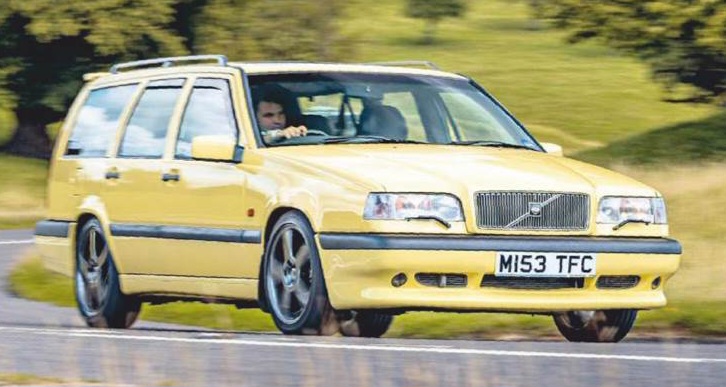
In 1991 Volvo unveiled the 850, the car that, according to a few experts, saved Volvo from bankruptcy. Thankfully the legacy of high-performance wagon continued with the 850-R (picture above), equipped with the amazing 5-cylinder, 2.3-liter turbo engine, capable of 250 hp, which might sound tame by today’s standards but it was very interesting back then. The Estate “R” was originally intended as a limited run of just 2,500 units, but the first batch sold out so quickly that Volvo felt compelled to make it a regular production car.
The 850 was the right car at the right time for the company, it might not be as pretty as a BMW 3 Series from the same era but it was a huge improvement when compared to the previous generation.
This modern and attractive car gave Volvo the confidence to face the competitors not only on the streets but on the race tracks as well. It was time to use racing as an advertisement tool.
From soccer mom’s car to track warrior.
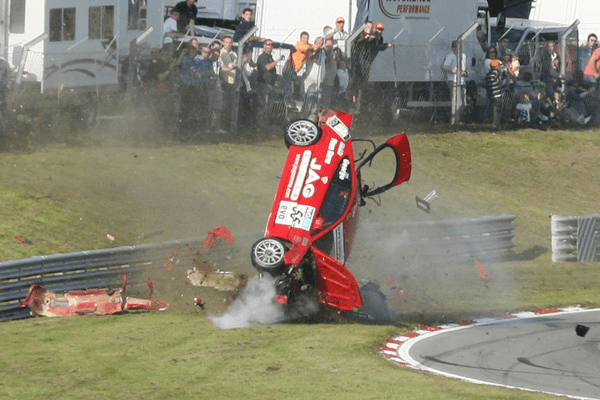
If an automaker wanted to use racing to advertise its products in the 1990s, there was only one place to be, the British Touring Car Championship. The competition, held in the UK since 1958, reached its peak in popularity in the 90s during the so-called super touring era. Thousands of fans flocked to the race tracks every weekend to watch the fierce battles between the drivers. The races were broadcast live not only all over Europe but across the globe as well. Manufacturers from Japan and Europe were not shy about pouring copious amounts of money into their official race teams and the level of competition on the tracks was unmatched. To understand how close fought those races were, please go to YouTube and dig some videos about it.

Volvo joined the BTCC in 1994, and the season was all set to be a memorable one. The Swedish team would be fighting against some formidable opponents. Brands from all over the world were represented there: Ford, BMW, Vauxhall, Mazda, Toyota, Nissan, Renault, Peugeot, and the second debutant that year, Alfa Romeo.
But the season would be remembered for one reason: Volvo chose to race the 850 Estate instead of the sedan.
Volvo was not fooling around when they joined the touring car war; the company formed a partnership with Tom Walkinshaw Racing (TWR), a British motor race team that was responsible for putting together the Jaguar XJR-9 that won the 1988 World Sports Car Championship, and also getting into Formula 1 through Benetton, pushing Michael Schumacher towards his first world title.
They were also not fooling around when the time to choose the drivers came. The 1988 Le Mans winner Jan Lammers and Swedish Formula 3 racer Rickard Rydell were hired to perform the driving duties for that season.

The decision to compete with the station wagon was kept in secrecy. Nobody knew until the two white and blue livered cars rolled out of the truck at the season opener race, in Thruxton. Everyone thought it was some kind of joke, even the drivers. “When I signed up for Volvo… I didn’t know about the estate plans,” Rydell said later. “If I’d known, I would probably have hesitated!
Overcoming a weakness
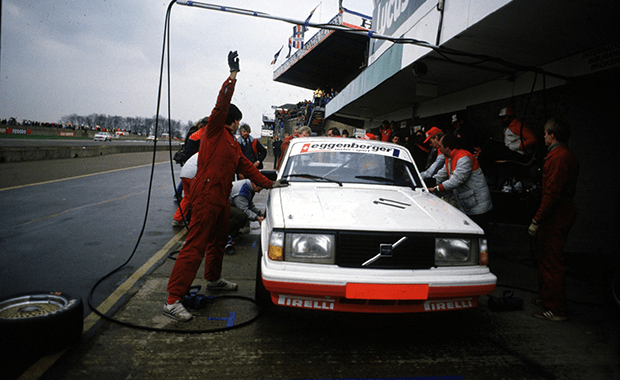
At this point, Volvo was no stranger to the race tracks. In 1985, the turbocharged, flame-spiting beast Volvo 240 won the European Touring Car Championship (ETC) and the German equivalent, the Deutsche Touringwagen Meisterschaft (DTM). The fans quickly adopted the underdog Volvo as their favorite and affectionately called it “The Flying Brick”.
But at BTCC, things were a bit different. Rules were strict – 2-liter maximum capacity for the engines and no turbo/supercharger assistance; throwing out the window the two main advantages of the Volvo 850. The downsized 5-cylinder Volvo engine, without the help of the turbo, became a very uninspiring powerplant, at a first attempt the team was able to squeeze a meager 260 ponies out of it.
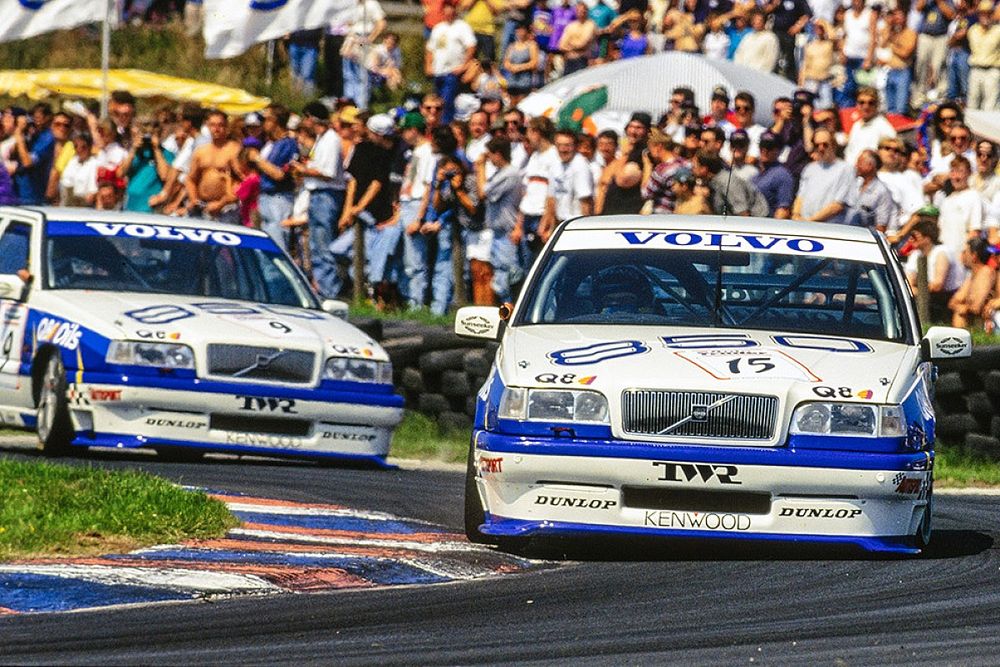
You don’t need to be a rocket engineer to figure that using the 850 Estate meant more glass and metal on a longer wheelbase. Although the wagon was a bit more aerodynamic than the sedan, the anemic engine put the Swedish team in a pickle.
Thankfully, the technicians at Tom Walkinshaw Racing were very resourceful. Turns out that the BTCC rule book was not that strict and the team explored every loophole possible.
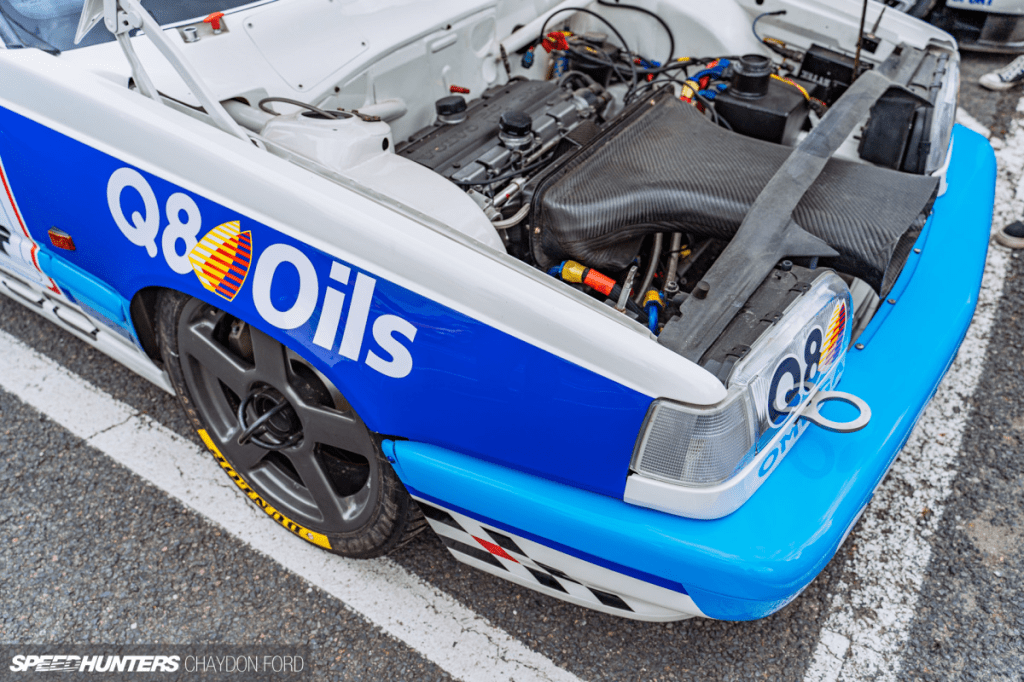
First, the absence of the turbo allowed the engine to be positioned further back towards the firewall, and the adoption of a sequential 6-speed transmission permitted the engine to be installed in a much lower position than in the original 850. All these modifications greatly improved the handling of the racing wagon.

The engine also received a lot of improvements, the rules stated the head should be the same as the production car, but it wasn’t specific about how much it could be altered. Volvo came up with camshafts so aggressive that they couldn’t fit inside the head and new supports had to be created to accommodate them.
Much bigger valves were used to improve the air-fuel flow. The rules didn’t allow to modify the angles of the valves so the team went to the extreme, altering the sitting angle of the head to the block and the intake manifold… WOW!!!! All these ingenious modifications kicked the power output to 300 plus HP. Not bad at all.

Besides all the efforts, not only from the TWR but from the drivers as well, the 1994 BTCC season fell short of Volvo’s expectations. During its debut (and only) season, the 850 wagon’s best results were 3rd in qualifying, and 5th in a race. Volvo finished 8th overall in the 1994 championship, beating only Nissan and Mazda.

We can not only focus on the lack of competitiveness of the 850 Wagon; at the end of the season, Volvo had achieved what they were looking for when they chose the car, publicity.
Alfa Romeo won the manufacturer title of the 1994 BTCC season, taking advantage of a controversial aerodynamic aid. Both cars became legends in the BTCC universe, and when we talk about the Super Touring Era, the first image that comes to mind is the red Alfa Romeos and the Volvo Estates “apexing” the turns on two wheels.
For the following season, BTCC changed the rules regarding aerodynamic aids, forcing TWR and Volvo to go conservative, using the sedan body instead. Volvo ended both the 1995 and 1996 BTCC seasons in 3rd place.

Just three racing wagons were made for the 1994 season. The first chassis then spent a period in Australia before returning to Sweden where it was rebuilt and restored to its original livery before being placed in storage.
The second remains on display at the Volvo Museum in Göteborg while the third model was re-shelled as a saloon and used as a test hack ahead of the 1995 campaign. The two remaining cars can be often seen at classic car racing events in Europe.
Today, the Volvo states from the 1980s and 1990s are becoming collector’s items and are no longer seen as “dorkymobiles”, but the 1994 BTCC season significantly helped to change the perception of Volvo cars from boring to somehow cooler, and sporty.
Note of the editor – Some pictures I grabbed without asking permission. I hope the authors won’t mind. The top one is from the amazing Wheels and Things blog – https://wheels-and-things.com/en/, and a couple from Speed hunters web page – Chaydon Ford
 The Classic Machines
This is a great article as usual. A minor correction to consider is that our word in the UK for station wagon is ‘Estate’ not ‘State’. For fun, an older term is ‘Shooting brake’ which dates back to when British Upper Classes would have special bodies made for their early cars to support them on shooting parties. There is a memorable Aston Martin DB5 Shooting Brake – nice. Also fun to look at what words manufacturers use for Estate such as BMW’s logical ‘Touring’ and Honda’s baffling ‘Aeroback’. Thanks for the article, keep ‘em coming
LikeLiked by 2 people
Thank you so much for your support. I already fixed my mistake.
Now that you mentioned it, I remember reading an article about the “Shooting Brake” cars, very interesting. The Aston Martin was in the main picture of this article.
LikeLike
Cheers – a couple of other names used would be Morris’ ‘Traveller’ and Citroen’s ‘Safari’
LikeLiked by 1 person
It is all about traveling, right? My experience with Estates comes from my dad, he was a big fan, and I inherited this passion. In Brazil, VW and Chevy named their wagons after idyllic beach cities, like Parati, Marajó, and Ipanema (remember Frank Sinatra singing “The Girl From Ipanema?)
FIAT was more obvious and named its wagon Weekend.
LikeLiked by 1 person
Also of note our UK police use these cars as motorway patrol vehicles, pretty rapid!
Had a few Volvos in the past. My favourite was my 480es sports coupe (engine Renault based) it was quite fast and handled like being on rails. Sadly electronic issues with the engine management system and the dreaded rust in rear wheel arches (the front end was all GRP) meant it had to be scrapped, had some fun with it when it went well, saw off many a boy racer’s ‘hot hatch’!
The BTCC is still going strong, the only roundy, roundy racing I like watching on tv.
LikeLiked by 1 person
My wife is an unconditional admirer of Volvo, she had a 2005 S40 Turbo that she had so much fun with. For me the car was a money pit, too many electronic problems and a coolant leaking that 5 different “specialists” could not fix. Maybe that specific car was problematic and I should not blame the brand, since we bought it used. I need to catch up with BTCC, I will try to find the races on TV.
LikeLiked by 1 person
Great article. My parents had a 1992 940 they bought brand new while living in Germany. They had a sedan, but I always liked the wagon.
LikeLiked by 1 person
I have a “thing” for wagons too, and the Volvo Estate is legendary.
Thanks for subscribing.
LikeLiked by 1 person