Once again it is wintertime in the Northern Hemisphere, and here in Canada, it means one thing: spending most of your free time indoors. If you are not willing to sit in front of the TV and spend hours watching Netflix’s “craparama”, you better find a hobby.
Occasionally, I give a shot at an old hobby I used to have when I was a kid, plastic modeling. My love for machinery made me spend my meager allowance on books, magazines, slot cars, and enough plastic model kits to drive my poor mother crazy every time she tried to dust them off.

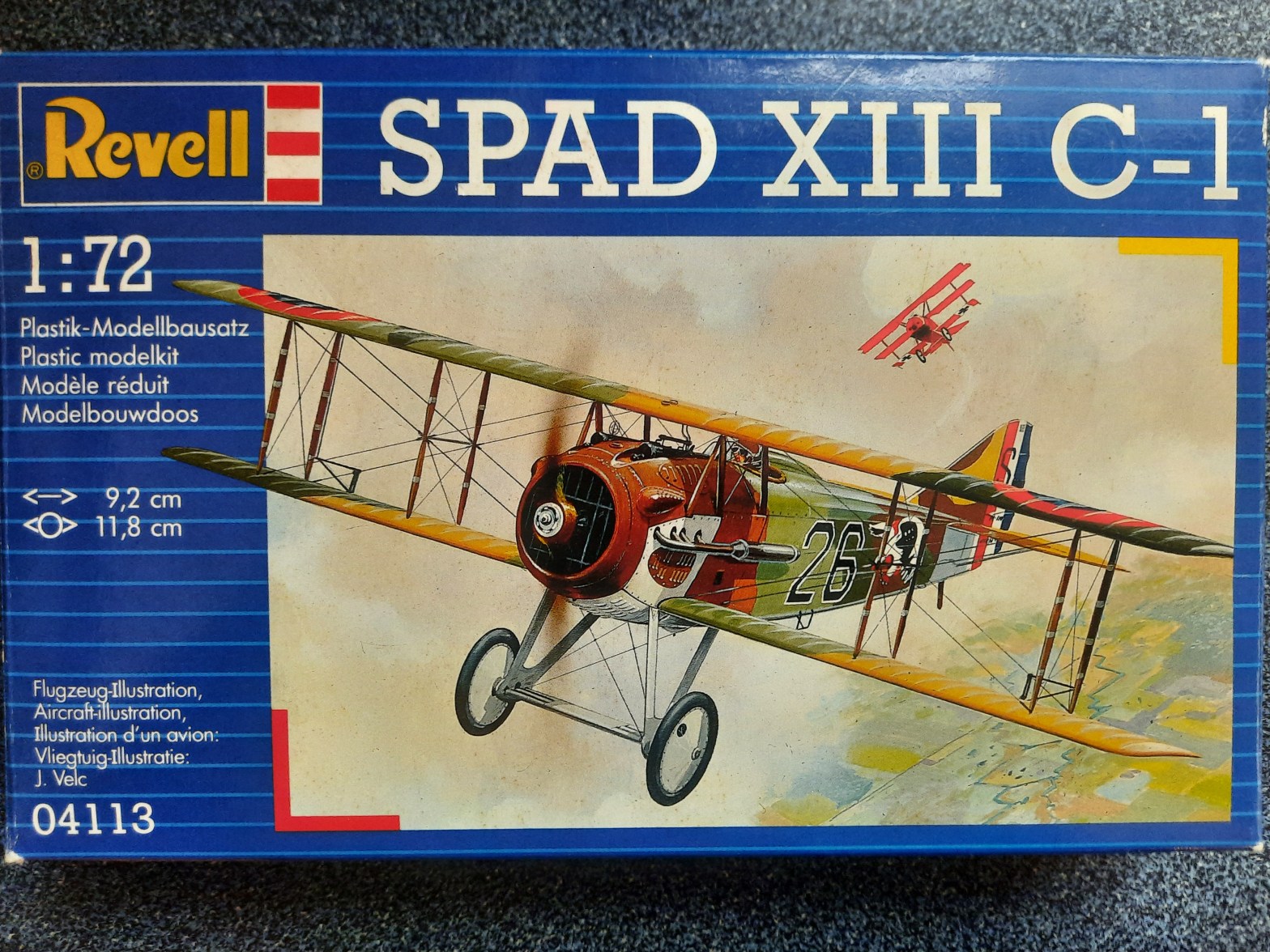
This Christmas I bought, as a gift for myself, an old Revel kit, a 1:72 French fighter Spad XIII that I found on eBay. In one of the pictures the seller sent me I found out the kit was made in 1991, which can be considered vintage. That is pretty cool.
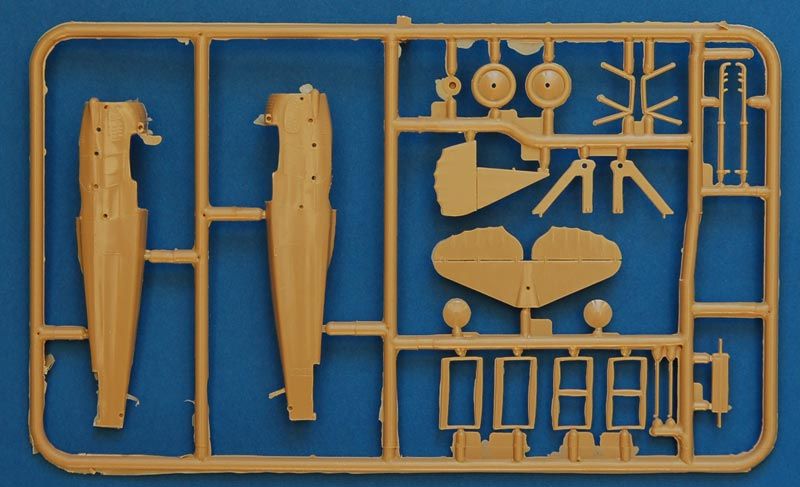
All the kits I bought when I was a kid were Revell, which was the most popular brand at the time in Brazil. I don’t remember ever having quality problems with them so, I felt confident in buying this one.
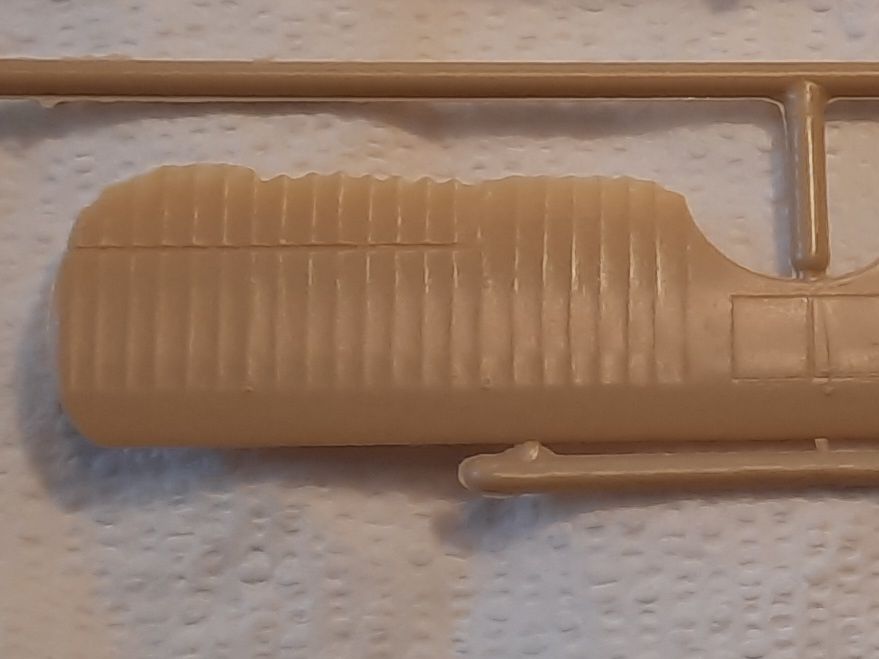
What a disappointment. This little kit came with several plastic injection defects, which the experts call “flash”. The worst piece was the top wing.

I had to fix it with sandpaper, which took me some time and a lot of patience.

The first step was to put the fuselage and lower wing together, which was pretty easy since it is a level 2 kit. After finishing this I celebrated with a beer and a bottle of Chinese apple cider. Perhaps it was a wise idea not to continue the building that night.

The next morning I attached the undercarriage and the engine cowling. Now it is time to start painting.
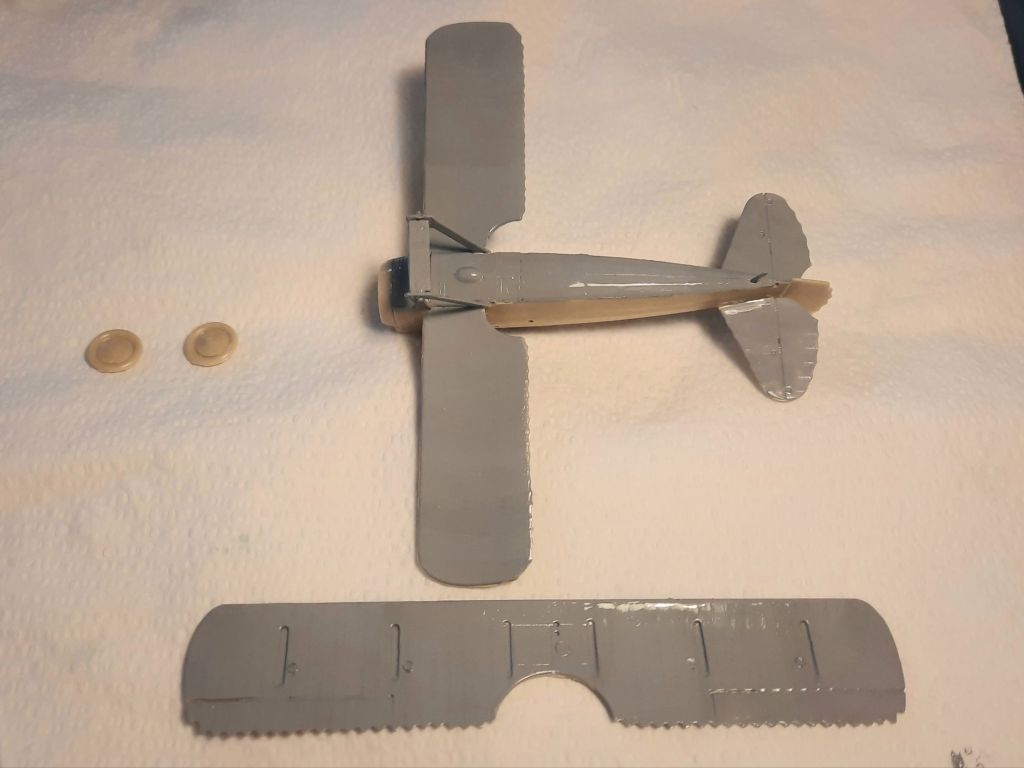
I decided to go with light gray for the underneath camouflage. The other option was light green.
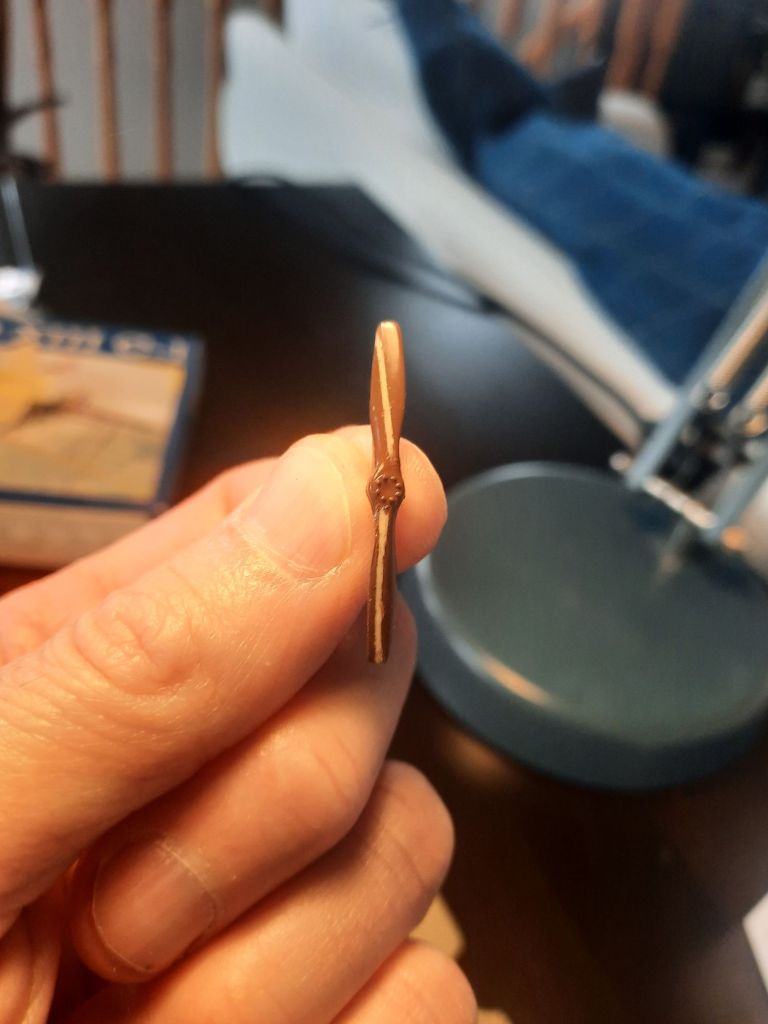
I tried a little trick to make the propeller look like laminated wood, but the result was not what I was expecting, I believe my masking tape is too old and didn’t do its job properly, but I decided to keep it like this anyway.

The kit has two options for the camouflage and decals, one is the famous Spad flown by the American ace Capt. Eddie Rickenbaker, who scored 26 victories during the war. The other one is the machine that belonged to another American ace, Second Lieutenant Frank Luke, also known as The Balloon Buster, who scored 18 victories.
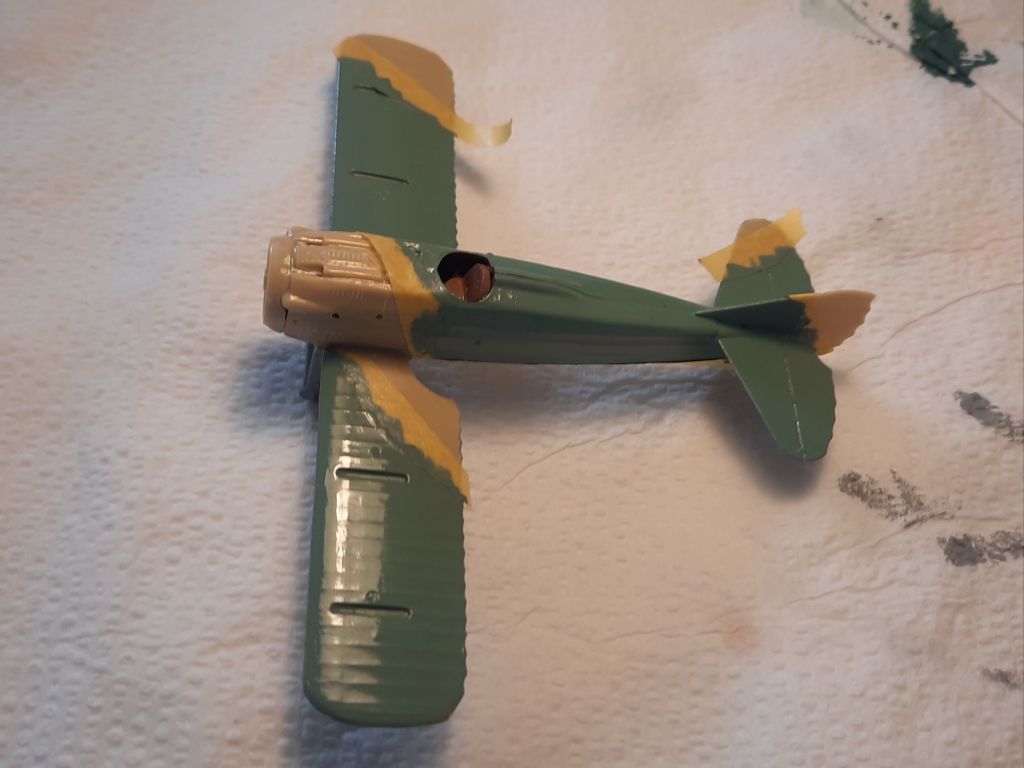
Both options follow the traditional 5 colors French pattern. But I decided to go rogue here.
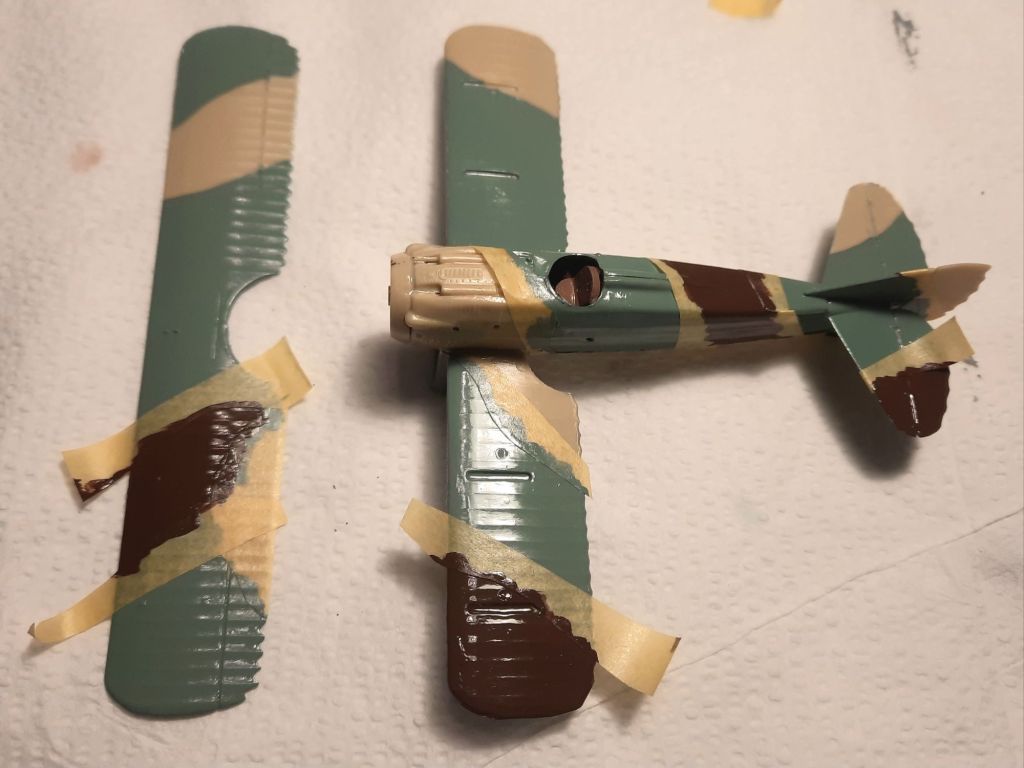
After a quick Google research, I noticed that 9 out of 10 Spads built worldwide are homages for those two American aces. That compelled me to do something different.

In WWI, the concept of a military air force was in its infancy, therefore, fighter pilots had a good deal of freedom in many aspects and one of them was choosing the livery of their machines (the Germans more so than the Allies). Based on this, I decided to create my own camo pattern with beige, light green, and brown.
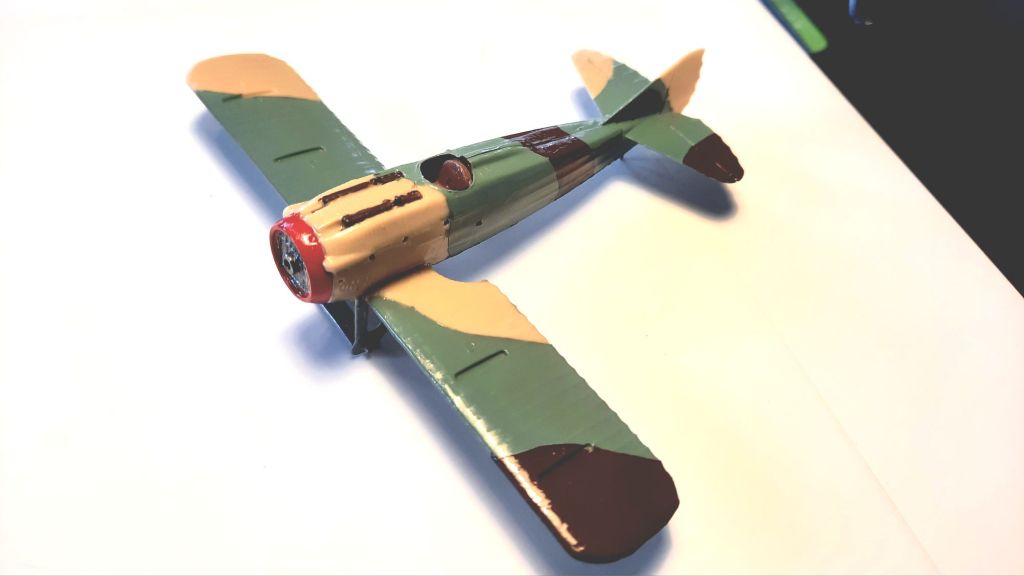
This pattern is totally made up and not historically accurate, which might sound a bit heretic but I think it looks good.

With the top wing and the decals in place, it finally looks like a WWI fighter.
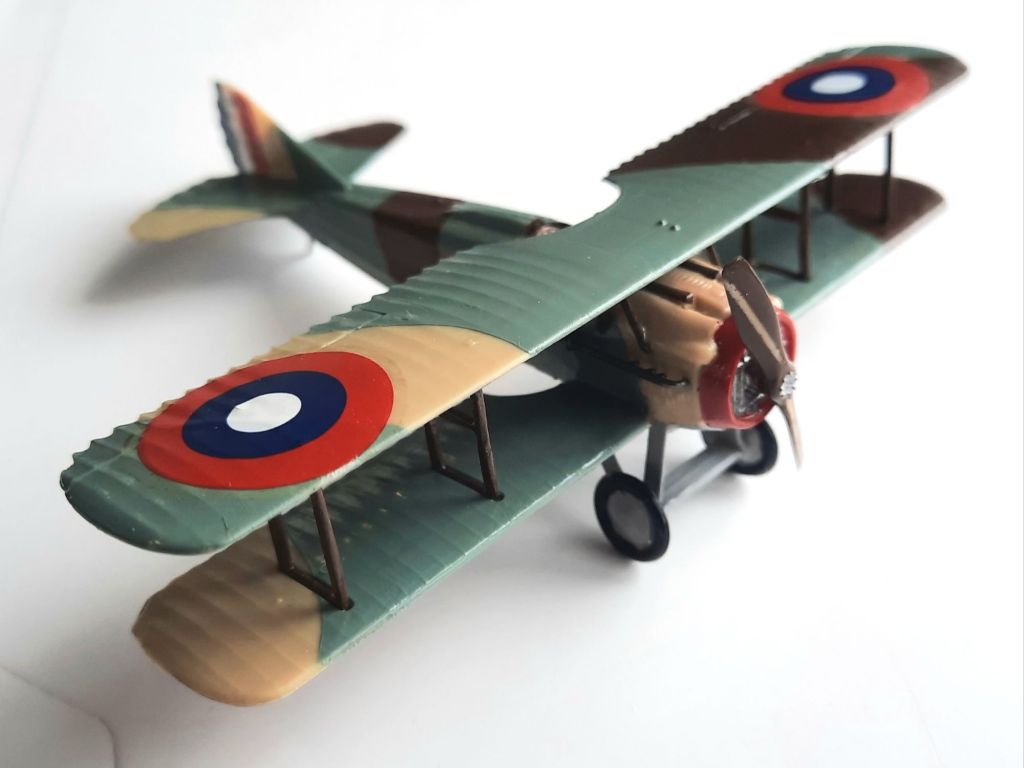
I was expecting to have a hard time dealing with 30-plus-year-old decals but fortunately, most of them behaved quite well.
At this point I can consider the model is done, even if it missing two very important details, first is the cable rigging and second is the weathering.
-Rigging–
Some biplanes (and monoplanes as well) either vintage or modern, use cables to enforce structural rigidity, as you can see in the artistic depiction of the Spad in the first picture of this post. When I started this building I had the intention to reproduce the cables using sewing thread but this is not the kind of job for an old man like me. My hands are too shaky and my eyesight is not very good so, I gave up even before trying.
-Weathering–
Model kits, especially military hardware, need to show some marks from the battlefield, otherwise, they will just look like toys. A model must have dents, rust, dirt, oil stains, bullet holes, and so on to make it look real. Weathering is an art and to achieve perfection a modeler must practice it for a while. I definitely don’t have what it takes but I am learning it. I tried to apply some dirt on the Spad a couple times, without success, but I am not giving up, as soon as I get it right I will update the post with new pics.
The machine

The Spad XIII was the latest version of a series of fighters built for WWI by the French Société Pour L’Aviation et ses Dérivés (SPAD). The first prototype flew on 04 April 1917 and during the time it served in the war, the XIII built a reputation for itself. Fast, maneuverable, well-armed, and capable of taking some punishment and still keeping flying, this biplane was adored by the pilots who flew it.
It was massively produced, with 8,472 units built until the time when the armistice was signed. The XIII equipped virtually every fighter squadron of the French Aéronautique Militaire, and it was also supplied to the UK, USA, and Belgium. After the war, the Spad XIII was exported to countries all over the world.
Armament: Two 7.7mm Vickers machine guns, mounted on top of the engine cowling, firing through the propeller.
Engine: Hispano-Suiza 8 – 11,76 liter, water-cooled V8, able to produce 220 hp @ 1,700 rpm.
Top speed: 216 km/h (135mp/h)
A fictional WWI tale.

It was very satisfying to put together a model kit that had been kept inside its box since 1991. I consider myself a below-average builder but even though I am happy with the final result. Since the camouflage pattern is fictional, I decided to write a fictional short (very short indeed) story about its pilot.
–This is the Spad fighter that belonged to Sargeant Jean Claude Sauvage, a French flying ace with 10 confirmed and 5 probable aerial victories. He was posted at Escadrille 38, in May 1917, and quickly proved to be a talented and fearless pilot.
On 8th August 1918, Sauvage was shot in his right leg during a reconnaissance mission, probably from a light firearm by an enemy foot soldier. He managed to come back to base but the injury put an end to his successful flying career.

During the time he spent in the hospital, Jean Claude fell in love with Martine Lambert, a Belgian nurse who took care of him. After the war, the couple got married and managed to open a small repair shop for bicycles on the outskirts of Paris, where they lived happily together ever after.–
Update – March 2024

I believe I got the weathering right, but I don’t think the picture will do justice to the result. I used oil-based black paint mixed with lots of solvents. I was having a hard time finding the perfect mix but then my wife Estela came to save me. She found it on her first try.

It is a very subtle dark shade, just enough to look like dirt and soot. I am happy with the result. At this time I celebrated with Irish red ale.
 The Classic Machines
I also used to build model airplanes when I was younger, but only of jets–usually jet fighters. One model that broke the mold (sorry, couldn’t resist) was one of the SR-71 Blackbird, which, of course, was not a jet fighter.
One thing that annoyed me on the SR-71 model was that the fins above the engines were not exactly perpendicular to the engines, but were slightly canted inboard. Of course, that was correct, but what was a pre-teen to know?
LikeLiked by 2 people
I remember having a similar annoyance when I was building a Phantom F4. The horizontal stabilizers are not exactly “horizontal”, and I could swear the kit was molded wrong.
LikeLiked by 1 person
My husband builds ship models-both wooden and plastic. He’s not thrilled with the Revell brand either. He weathers his plastic models by dry brushing them with duller paints.
LikeLiked by 1 person
Thanks for the tip. I will definitely give it a try.
LikeLiked by 1 person
Great article, keeping it real as always! I loved hearing about fictional Jean and Martine…did they have kids I wonder…?
LikeLiked by 2 people
Thanks, I am happy you enjoyed the article.
I fact, they had a son, Marcel Sauvage, who was born in 1920. The young Sauvage enlisted in the Armée de terre and was dispatched to Marrocco. When France fell to the Nazis in 1940, Marcel fled to UK and became a SOE agent (Special Operations Executive). He was sent back to France as a spy, conducting acts of surveillance and sabotage against the Nazi regime.
Gosh! I think this could easily become a book.
LikeLiked by 1 person
That’s fab. Did he meet and fall in love with an English girl I wonder. Maybe she worked at Bletchley Park as a code-breaker? After the war did they get married? 😀
LikeLiked by 1 person