
The 1980s was not a remarkable era for the auto industry, the decade will always be remembered by sluggish engines and questionable taste in design. But if we venture into the realms of Italian exotic cars we will certainly find a few exceptions. In my humble opinion, the Ferrari 288 GTO can easily sit on top of any list of the most beautiful cars of the 1980s.
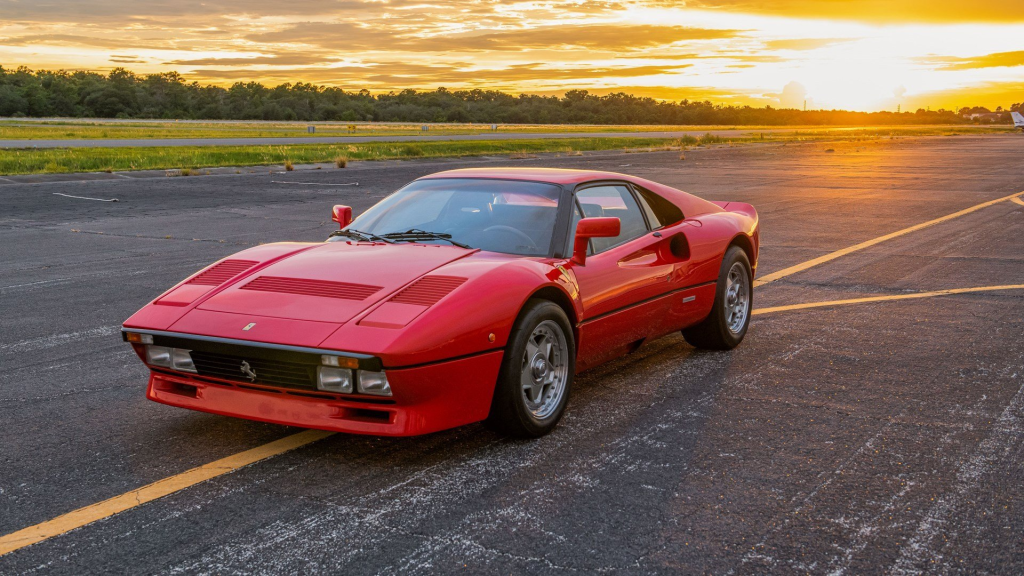
This Lady in Red is not only gorgeous, she is also fast. The car is powered by a 400 hp twin-turbo engine. and the stunning design is a creation of Pininfarina. To make her even more desirable, Ferrari produced just a hand full of them.
The 288 GTO was born as a more affordable version of the 308 GTB and was produced from 1984 to 1987. At some point, Maranelo was granted permission from the top FIAT CEOs to create the Evoluzione, a specially modified 288 for road racing and Group B rally. I believe the idea of seeing the car competing in the legendary Group B helped elevate the 288 to iconic status.
The 288 GTO is a rare car, with only 272 units produced. The very last one was given to Niki Lauda by Enzo himself. A 288 in good condition (and let’s assume most of the surviving ones are in excellent condition) can fetch prices between $2.5 million and $3.5 million.
After this quick introduction, we can get to know the 288 GTO which is the subject of this article.
The fastest Ferrari on earth
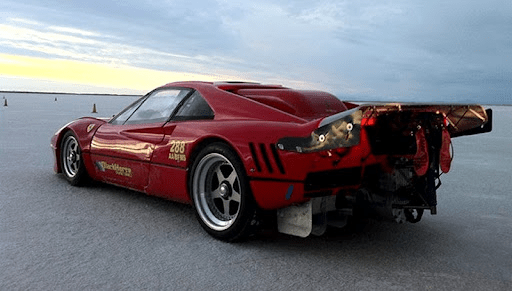
The title above might be a bit misleading and the reason is simple, the 288 we see here can’t be considered a true Ferrari, in fact, it can’t even be considered a true GTO. The modifications performed in this car are so extensive that the it lost its soul and became some kind of monster, a mechanical Frankenstein.
But when I say this Ferrari became a monster, I am not saying it in a derogatory way, what I am trying to say is this beast was stripped of its original soul and received a different one. This new soul gave the car a different purpose in life.
It is a fact that money gives you the freedom to make your dreams come true and, exponentially, lots of money will give you way too much freedom. Perhaps this is how this journey started.
After watching the movie The World’s Fastest Indian, back in 2005, the American retired banker/adventurer/explorer/race driver Stephen J. Trafton became inspired to go to the dry lake and break some records himself, but he wanted to do it in style. He wanted to go fast in a car that was born to go fast. He wanted a Ferrari.
Well, before we move into this idea, let’s talk about Bonneville.
The Salt Flats
This magical place is located in Utah, USA and it is a race track like no other. The 12 miles-long and 5 miles-wide ancient dry lake bed has a perfectly flat surface, making it ideal for speed trials. Men and machines have gathered there since 1907, when the first land speed record was registered.
Five major racing events happen there every year, including the legendary Speed Week. This is a democratic place where any kind of machine is welcome, from motorcycles to jet-powered trucks. Although the salt flats are an environment where the traditional American hot rod feels more at home than anything else, it is not unusual to see European exotic cars going flat out on the track.
Now, let’s go back to the machine.
The Flying Horse
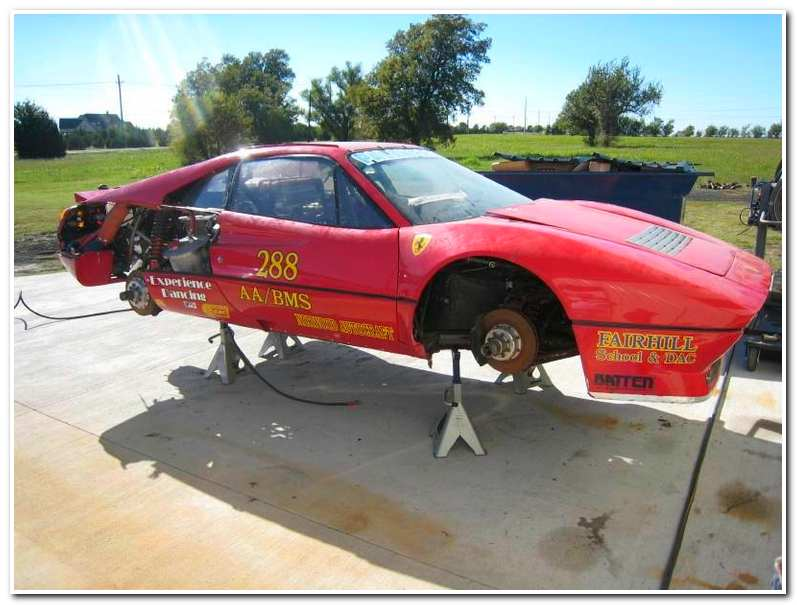
Trafton wanted something different for his adventure and in 2007 he bought a retired, Ferrari Bonneville racer for $75,000. It is a 1985 308 GTB that was re-bodied as a 288. The car had seen its fair share of abuse on the dry lake and after sitting for 8 years in storage, the poor Ferrari was in rough shape. The car was taken to P4 by Norwood, a garage that is specialized in tuning and customization of Ferraris. They even build replicas of the 1967 P4-300.
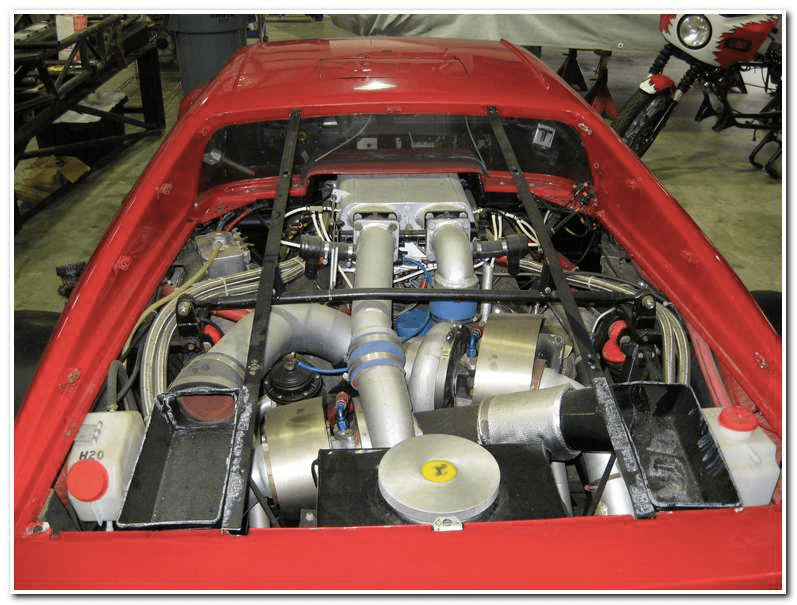
The car was halfway done when Trafton bought it. The Ferrari was already fitted with a Chevy V8 and a 4-speed tranny with CO2 shifting, just like in top fuel dragsters.
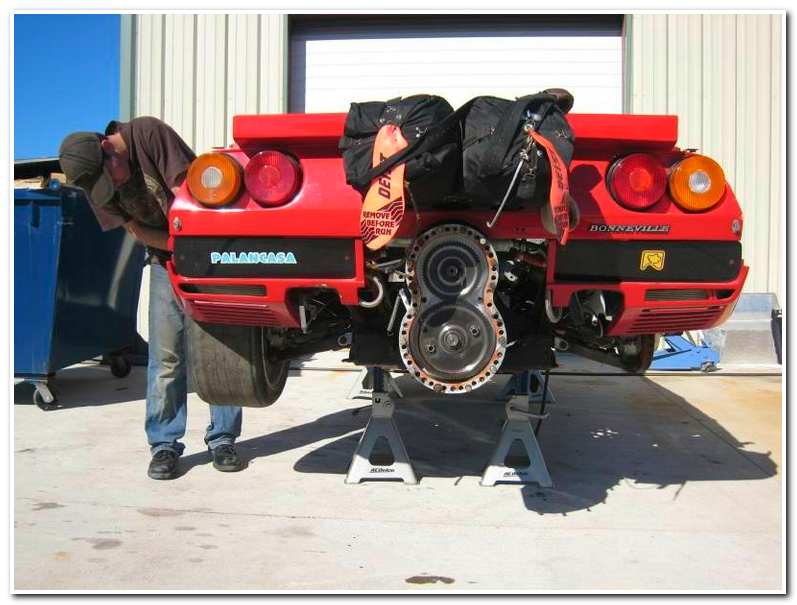
The car’s powertrain has an interesting configuration, the engine is connected via shaft to a V-drive (those into boat racing/performance know what I am talking about), the transmission is bolted to the lower part of the V-drive and then connected to the rear end. Confusing? You bet, but let’s take a look at the picture below.
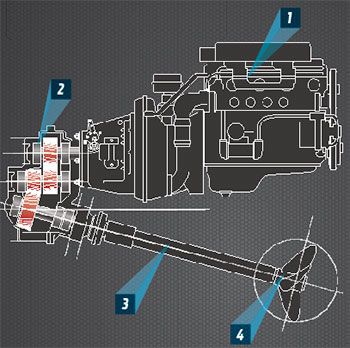
I got this diagram from a boat parts website but it will give a good idea of the Ferrari’s setup, #1 is the engine (duh!); #2 is the V-drive; the tranny goes exactly where #3 is, and #4 would be the rear diff. Voila!! It is called V-drive because of the angle between the shafts but the one used in the Ferrari probably has parallel shafts.
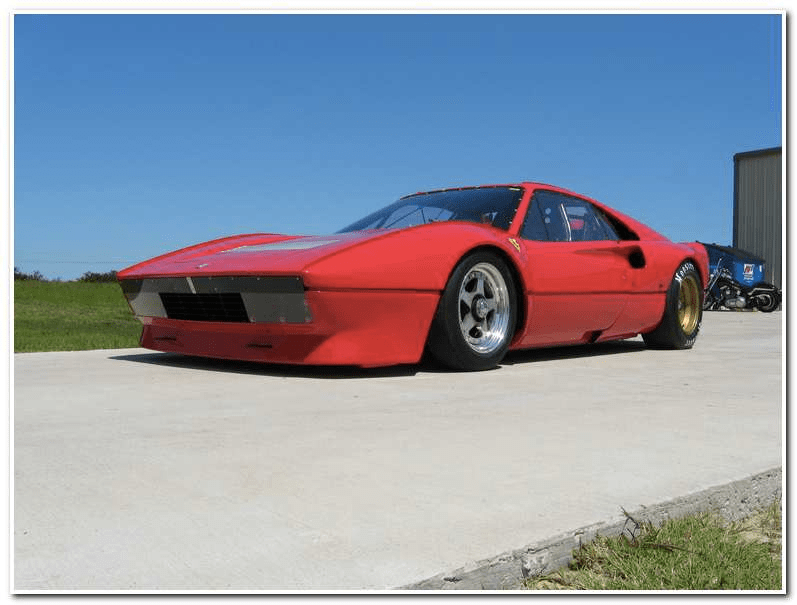
In 2008 the Ferrari was ready and… Gosh!!!! She looks amazing!!! An original 288 is a beautiful car but a race-ready 288 is way beyond that. The car was then christened “Cavallo Volante” which means Flying Horse in Italian.
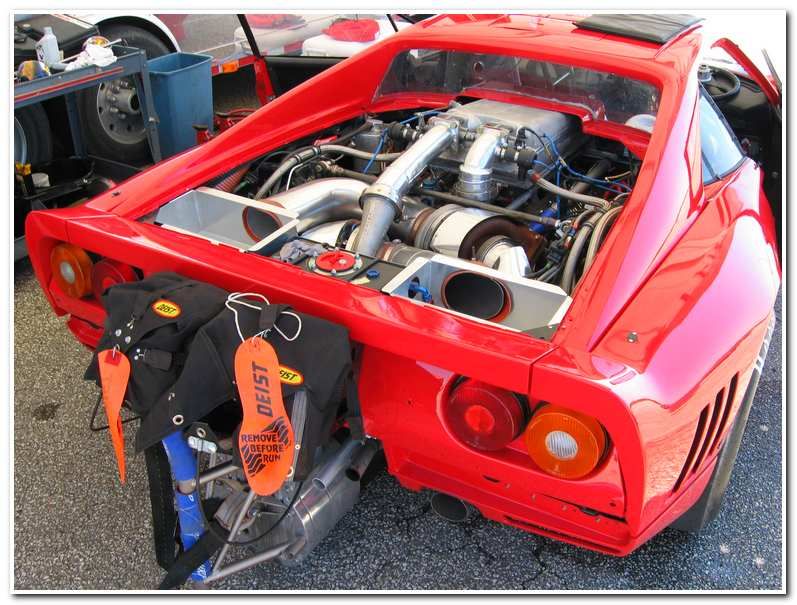
Here some interesting details of the Cavallo Volante, after the restoration:
*540 CID all aluminum big block Chevy, custom built by Dart, equipped with two 96 mm turbos. Dart also supplied the aluminum heads. Depending on the tuning, the engine can crank up between 2500 and 3000 hp.
* Custom intercooler with stainless tank in front
* MOTEC engine management
* B&J four-speed transmission with CO2 shifting – Equipped with internal clutch packs.
* Custom Overdrive gears back into Ford differential, turned upside down (because of the V-drive setup)
* Dual fire systems
*High and low-speed chutes
* Micky Thompson Bonneville experimental tires (tested at 600 mph)
* Rear spoiler and ground effects, plus 500 lbs lead ballast at the nose, helping to keep the front wheels operational at high speeds.
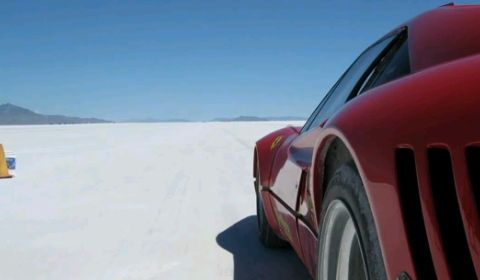
After spending some time tuning the engine at the dyno, the car was taken to Bonneville Salt Flats for Speed Week in August 2008. The team entered the AA/BFMS class (AA – larger than 500 cubic inch displacement engine: BFMS – Blown Fuel Modified Sport). Tom Stephens, an experienced Bonneville driver was behind the wheel that weekend and after several test runs down the 5-mile course, Stephens dropped the hammer, full of hopes for a new record. Unfortunately, the big block Chevy gave up after so much abuse. The engine exploded, causing a fire that was quickly put out by the car’s safety system. And that was the end of the team’s first attempt to set a record.
The Ferrari was properly repaired in 2009, the engine was rebuilt, and received an improved intercooler system, increasing the horsepower and durability. Around this time, the team owner, Stephen Trafton, started his quest to become the official driver for this enterprise.
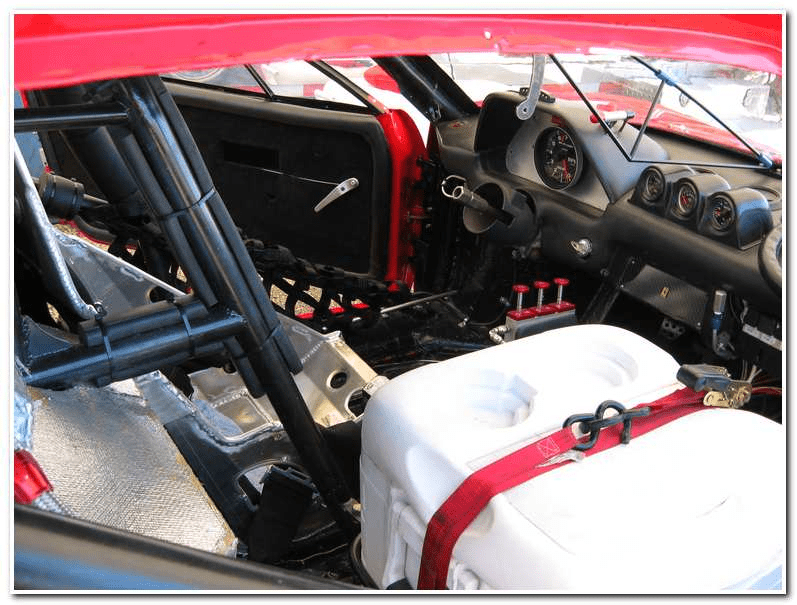
The Cavallo Volante was then sent to the Dallas Raceway, where Strafton got some “seat time” in the car, getting himself ready for Bonneville.
In October the team was back to the Salt Flats for the 2009 World Finals. During this meet Strafton qualified for the Unlimited Speed License (license to drive at speeds greater than 250 MPH). He was one of the few rookie drivers to ever pass all qualifications for this license in one racing meet. The 288 performed flawlessly, setting high expectations for the next year.
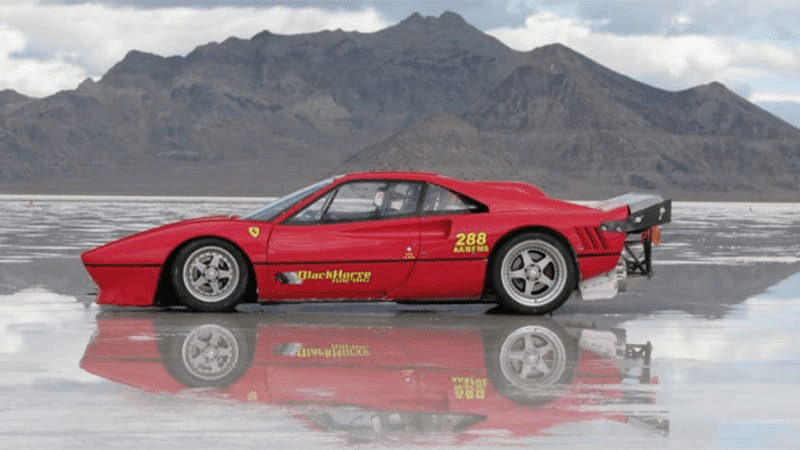
And finally… The record.
In the first part of 2010, the Ferrari received a totally new turbocharge-intercooler system, allowing the massive V8 to easily pump out solid 2000+ hp. The team was hoping the engine would hold its bolts together during the required two flat-out passes, which are then averaged to set a possible record.
In October 2010, the team was back to Bonneville for the World Finals. For the first couple of days, Strafton took the Cavallo Volante down the track five times, testing and tuning the package. On October 8th,, for the first time the car clocked a speed that confirmed the record was within reach – 276.152 mph or 444.423 km/h. That was enough to qualify for a final record run the next day. The performance even surprised the race officials. They never thought a stock bodied car, driven by a newly licensed rookie would go over 250 mph.
According to the rules, the Ferrari was then taken to a restricted area, where the team had 1 hour to perform some minor adjustments and get it ready for the next morning.
October 09, 2010 – The final Record Run day. All the teams that had their machines qualified the day before were at the starting line for the Final runs. The Black Horse Team was one of the first to go down the track.
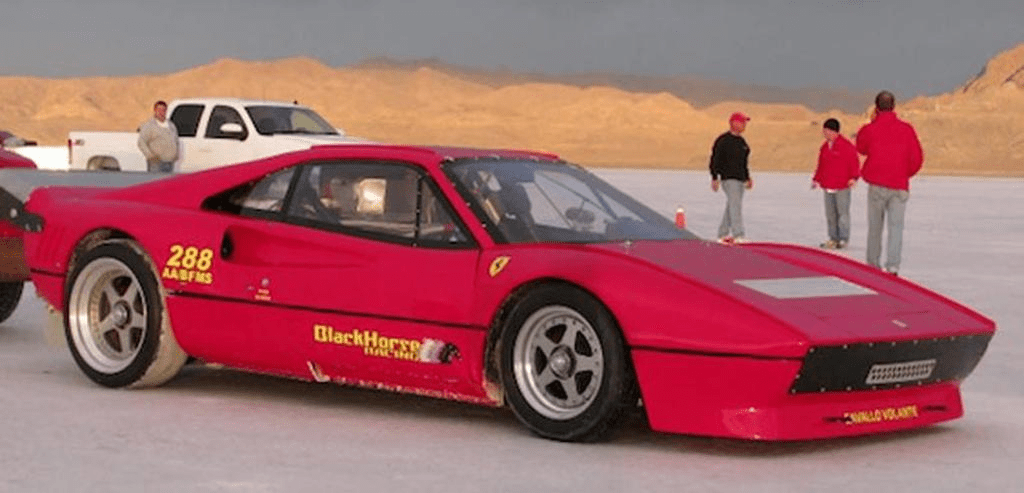
After waiting about ten minutes, the starter gave the go-ahead and the Cavallo Volante was off, for the all-or-nothing double pass. There was a soft spot between miles 3 and 4 so Strafton picked a narrow line to the left of the track and tried to guide the car along, making hundreds of tiny steering corrections as the car drifted first left then right down the track. He also discovered that he was having vision problems in his right eye. He put his visor up after the start and shut that eye. (He underwent retinal repair surgery one month later.)
Strafton was determined to get that record. Concentrating on the left edge of the course and shifting through the gears at full throttle (from 1st to 2nd at 90mph, 2nd to 3rd at 140 mph, and 3rd to 4th at 205 mph). After completing the down-the-track and return pass, the car scored an average speed of 274.650 mph (442.006 km/h) and set a new world record of 275.401 mph (443.214 km/h) for the BFMS – Blown Fuel Modified Sport. Mission accomplished.
A final consideration
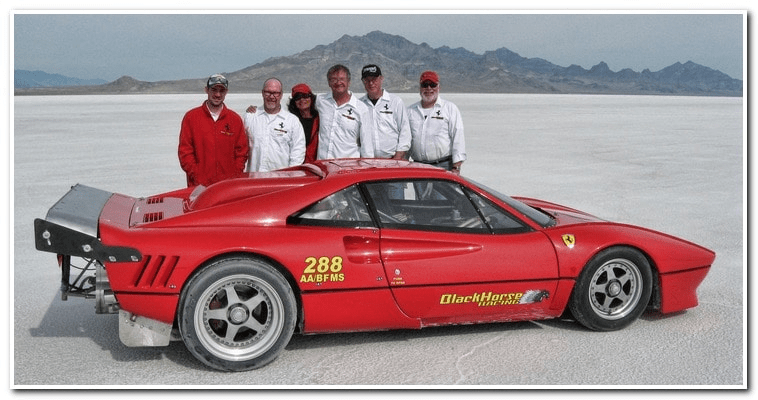
A couple of weeks ago, I was watching an old episode of the TV show Roadkill, and I saw a statement written on a car: “Nothing is sacred – Chop’em all”, and it seems the Black Horse Team followed this motto to the letter. What was done with this 288 (or 308) can make any Ferrarist puke in disgust but a true Hot Rodder will certainly see the excellence in this creation. An original 288 GTO can reach a respectable top speed of 189 mph (304 km/h), but can you make it go faster? I mean, a lot faster? Yes, you can. If you have the ingenuity and enough money (and the balls to step on it after it is done), you can make it happen, and that is the beauty of Hot Rodding.
What the Black Horse Racing team achieved is no small feat and they deserve to be praised.
As for the machine, aside from occasional trips to the local Seattle area car shows, the Cavallo Volante sits peacefully inside a showroom, far away from the excitement of Bonneville. It is a bit sad to see such a magnificent car retired from the competition, but who knows? Mr. Strafton might feel the Need for Speed and bring this Flying Horse to the Salt Flats one more time.
 The Classic Machines
Nice read.
Italian sports cars are not my cup of tea but this one is rather tasty!
LikeLiked by 2 people
Yes, it is a spicy Ferrari indeed. I would love to hear that Big Block screaming going flat out at Bonneville.
LikeLiked by 1 person
In the 1970’s my brother drove a bright orange GTO Judge. Just the sound of the engine would turn your head. 🙂
LikeLiked by 2 people
You’ve just got yo love big American V8 engines!
LikeLiked by 1 person
I had a chance to drive a 1968 convertible GTO once, but I didn’t even take the car to the road, it was only around the parking lot of the shop where I used to work in Brazil. You are right, the sound of the big V8 is awesome.
LikeLiked by 1 person
Thanks for sharing this idea Anita
LikeLike
Thank you for checking it out.
LikeLiked by 1 person
A couple things I just HAVE to say.
.
A Chevy V8 and a 4-speed in one of Maranello’s machines would make Enzo turn over in his grave!
.
But its also incredible that an American V8 can be turbo-ed and tuned to over 2,000 HP. I don’t remember if the article mentioned what type of fuel was used (I’d be interested).
.
500 lbs of lead in the nose so the steering would function. Wow! I guess putting a massive wing on the front wasn’t an option (stock body).
.
Great article, Rubens!
LikeLiked by 1 person
Thanks, Chris. I am happy you have enjoyed it. Good point, about the fuel. None of the sources I researched said anything about it.
My guess would be Methanol.
LikeLike
If a Chevy engine in a Ferrari can make Enzo turn over in his grave, a Ford-powered Ferrari would make him jump out of the grave and walk around like a zombie, looking for revenge.
LikeLiked by 1 person
Agreed. Imagine an engine from one of those ‘ugly little cars built in an ugly factory’ powering a beautiful Ferrari!
.
I noticed that in the speed record 288 GTO they used a Ford 9″ diff. There must be so special about that device. Always being used in race cars.
.
Hats off to the engineers who designed it.
LikeLiked by 1 person
Don’t be too sure of that.
Enzo Ferrari knew Bob Norwood, and as his legal team were going after McBurnie and Koenig, Enzo approved Norwood’s P4 replicas in writing.
Bob Norwood is an asset to the Ferrari legacy.
I own one of Norwood’s turbo Ferraris. A 328 GTS originally owned and commissioned by John Carmack. Yes, the same John Carmack with the 1000hp Testarossa and twin turbo F50.
LikeLiked by 1 person
Interesting & insightful, sir.
LikeLike
Sometimes I think it’s crazy what hot rodders will / can do. Crazy in a good way. Great story.
LikeLiked by 2 people
It is truly amazing what those guys can do. I have seen some great cars, built from the scratch by hot rodders with no academic background whatsoever. It is mind blowing.
LikeLike