
– In 1969, a team of Argentine racers, led by Juan Manuel Fangio, won one of the most gruesome endurance races ever, driving an unlikely race car. This is their story.
No, it is not a typo. The first time I came across this amazing story, I also thought: ” You mean 24 Hours of Nürburgring… Right?!?!”. Actually, no!!! The race, in fact, extended for 84 excruciating hours. Three and a half uninterrupted days of racing, in the rain, and fog. 84 hours of praying for the drivers and the mechanics to stay awake and to keep their sanity. And of course, praying for the cars not to fall apart.
To understand the scope of this Argentine achievement, we must understand the 3 most important components of this adventure: the race in which they competed, the boss who was in charge, and the car they raced.
The race
The concept of endurance racing was born more as a test bench for the automakers than as a motorsport genre per se. During the automobile’s infancy, between the 1910s and 1920s, the most popular form of endurance racing was rally, after all, there is no better laboratory for auto brands to test their products than the roads used by daily drivers.
In 1931, the Marathon de la Route was created, as a series of road rallies crossing the European continent and beyond. The longest chapter was a 3,500 km, non-stop round trip from Liege, Belgium to Rome, Italy, and back (later it became Liege-Sophia-Liege). Obviously, the race was not completely “non-stop” since drivers needed to be replaced and cars needed to be refueled, but the pit stops should not exceed 30 min. After WWII the number of cars, trucks, and buses increased considerably around the world and some countries started to impose restrictions on auto racing on public roads. The 84 Hours of Nürburgring was created in 1965 as a safer replacement for those long-duration rallies.

Although not nearly as glamorous as the other endurance races and mostly unknown to modern race fans, the 84 Hours of Nürburgring was extensively used by automakers to test their products. It was held between 1965 and 1971 and was intended for production cars only.
Now that we know a little about the race, it is time to talk about the most important element in the Argentine team, their boss.
Fangio

If you ever see a list of “The best Formula One drivers of all time” and you can’t find Fangio among the top 5, just throw the list in the garbage.
Juan Manuel Fangio began his racing career in Argentina in 1936, driving a 1929 Ford Model A that he had rebuilt in his own repair shop. After winning everything possible in South America in the 1940s, Fangio crossed the Atlantic, seeking more racing glory in the Old Continent. He had the honour of participating in the first Formula-One championship in 1950, racing for Alfa Romeo. At 39, he was considered way too old for a rookie in the European Grand Prix universe, but in the following years, Fangio proved that age is, in fact, just a number. He won nothing less than five world titles: 1951 (Alfa Romeo), 1954 (Maserati), 1955 (Mercedes-Benz), 1956 (Ferrari), and 1957 (Maserati).
Fangio retired from professional racing in 1958 while he was still on top. His status as a living legend allowed him to navigate freely not only around the international racing community but also through the corridors of many automakers in Europe and South America. With all his connections and influence, there wouldn’t be a better person to lead the Argentine team in this adventure.
Now we must talk about the third component of this enterprise, the car.
The Argentine Torino
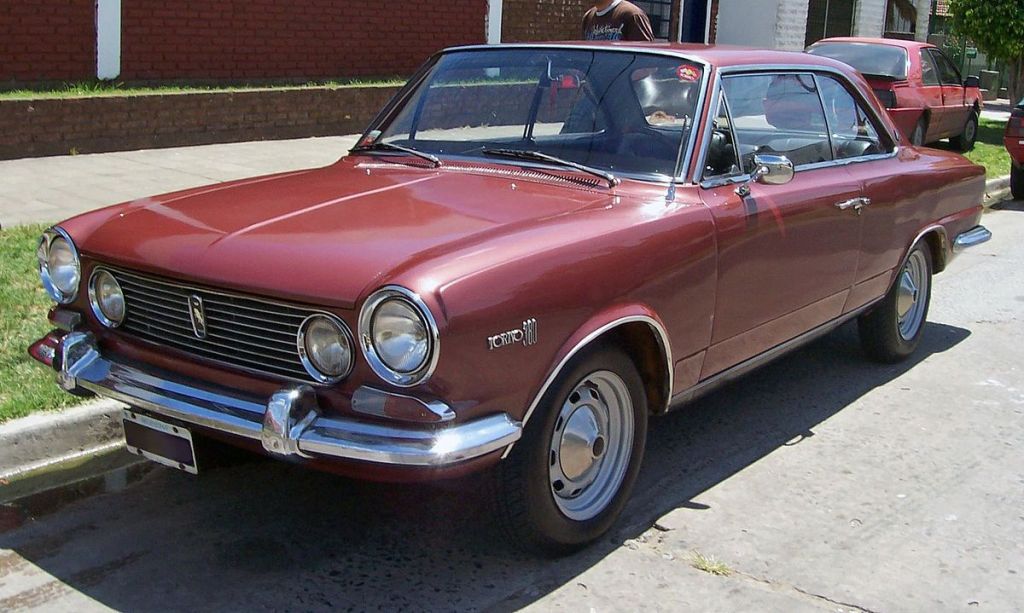
Right after WWII, some countries in South America were willing to show the world that they could produce more than agricultural goods. Brazil, Argentina, Venezuela, and Chile were gearing up to make all sorts of machinery, ships, and trains, but no other machine could ignite the pride of a nation as much as a car. During the 1950s and 1960s, many European and American automakers answered the call and opened factories in South America, lured by the prospects of a booming economy in the region. Some small brands struggling in their home countries saw this as an opportunity to strive in a less crowded and less competitive market.

In 1956, Industrias Kaiser Argentina S.A. (mostly known as IKA) was founded, as a joint venture with the American Kaiser Motors. The company produced a variety of Kaiser/Jeep vehicles and the AMC Rambler. In 1967 Renault started a slow process of acquisition of IKA, which ended in 1970.
By the early 1960s, IKA wanted a car that could stand out from competitors, something like a sports coupe. Since the budget for this new project was short (welcome to South America), the company had to do it with an off-the-shelf product.
IKA sent two 1964 AMC Rambler to Pininfarina, one coupe and one 4 doors, and asked them to transform it into something beautiful. The changes performed by the Italians were minimal, perhaps the idea was to save as much money as possible on new tooling. The result was an elegant car with an unequivocal European charm.

Under the hood, things got a little more complicated. With no money for a brand-new engine, IKA depended on the ancient Kaiser/Jeep 226 CID flathead, in-line six engines. This is not the kind of machinery anyone would expect to see powering a car with GT aspirations, but thankfully, the team had some money left for a few upgrades.
Kaiser Chief Engineer A.C. “Sammy” Sampietro designed an aluminum SOHC, hemi head, that improved immensely the breathing capability of the engine. IKA offered a 3 litre (183 CID) – 120 HP as the entry-level mill and a 3.7 litre (230 CID) – 150 HP as the performance option. The new engine was called Tornado.
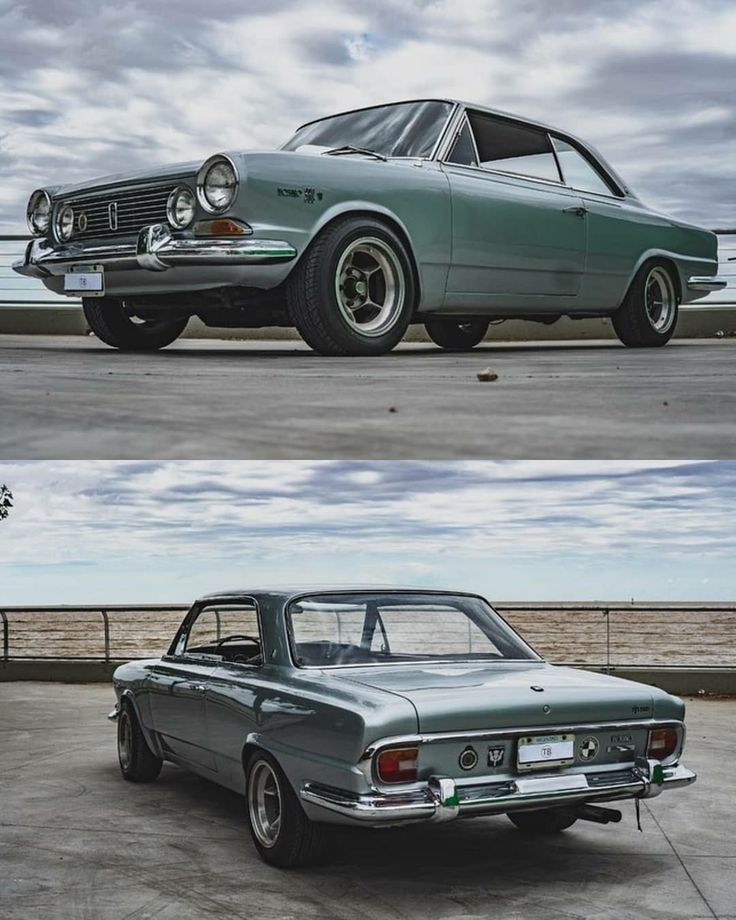
IKA also redesigned the awkward Rambler’s rear suspension, giving the car better handling. Closing the mechanical package, the engine was bolted to a trustworthy ZF four-speed manual transmission (a 3-speed auto tranny could be special ordered). The car was christened Torino and released in 1966 (2 years before Ford released their Torino).

The IKA Torino was an instant hit. The car boosted the company’s sales and gave it enough firepower to face the big dogs Ford, Dodge, and Chevy.

Later on, the team improved the engine block, increasing the number of main bearings from 4 to 7, allowing them to squeeze more power from the Tornado safely. The high-performance version of the Torino called 380 W, had a more aggressive camshaft, higher compression ratio, and three side draft Weber carbs, kicking the power output to 250 HP.
The “W” Torino proved to be a competent race car and started to collect victories on race tracks in Argentina and all over South America.
Even if the Torino was heavily based on the AMC Rambler, the Argentinians always saw it as a 100% domestic creation. The car became the pride of the country, a symbol of the nation’s industrial ingenuity. When the idea of an Argentinian race team competing in Europa started to gain momentum, they knew this team couldn’t be driving anything other than the Torino.
La Mission Argentina
The idea of “Win on Sunday, sell on Monday” was, and still is, widely used by the South American auto industry. In the 1960s, every automaker had its own official race team, and the drivers would wear the brand’s logo as proudly as a soccer player would wear his team’s jersey. When the rumours that Fangio was assembling a race team to compete in Europe, everybody jumped in. Even the head of General Motors in Argentina called Fangio to wish him good luck.
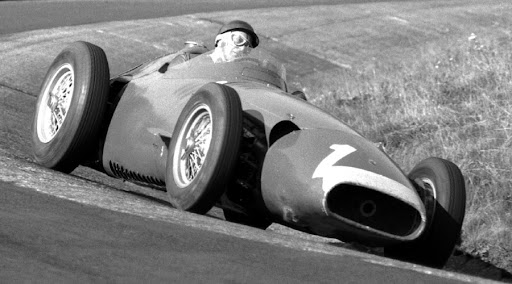
The idea of choosing the 84 Hours of Nürburgring is easy to understand. First, it was an endurance race intended for production cars only, with no sports prototypes stealing the show; the team had an excellent chance to score a good result. Second, Fangio had won there three times (1954, 1956, and 1957), which means he knew all the tricks to tame the “Green Inferno.”
The Wizard

What makes a street car become a race car is much more than the collection of high-performance parts installed in it; it is the talent of the people who installed them. In 1966, IKA had the privilege to hire a guy who was, perhaps, the most talented race engineer in South America, Orestes “The Wizard” Berta. By the time this idea of racing in Nürburgring came, he had already made the Torino a National Champion in 1967.

Berta, as the team’s chief engineer, prepared 3 Torinos for this adventure. Surprisingly, the cars were pretty close to the stock 380 W. The idea was not to make them super fast but super reliable. The vehicles received the numbers 1, 2, and 3, and as you can see in this picture, the front facia of each Torino was painted in a different colour, making it easy for the pit crew to identify them.
The Drivers
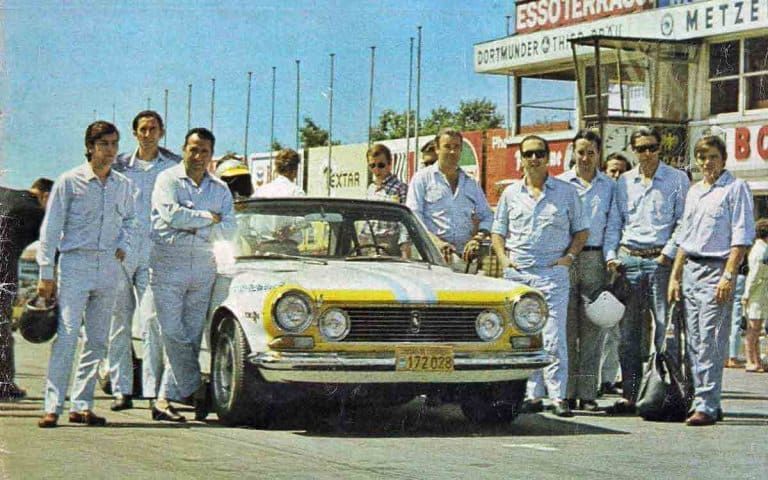
Fangio called only the best Argentinian drivers to be part of the team. Even his son, Oscar Fangio, was drafted.
Torino #1: Carmelo Gabalto, Oscar Fangio, and Rubén Luiz de Palma.
Torino #2: Gaston Perkins, Rodríguez Canedo, and Jorge Cupiero.
Torino #3: Rodríguez “Larry” Larrreta, Eduardo Copello, and Oscar Mauricio Franco.
Let the adventure begin
In July, Orestes Berta and his team of 6 technicians traveled to Hamburg, Germany to receive the Torinos. From there, they transferred the cars and equipment to the city of Chaudfountaine, in Belgium, for the symbolic start of the race, in July 30. The teams had 4 hours to reach the race track in Nürburg – Germany. This first stage of the race was a homage to its original format as a rally, and it was intended to be more like a parade than a competition since 4 hours is more than enough time to cover the 157 km that separates the two cities. To curb the drivers’ enthusiasm, every traffic ticket would be rewarded with a 5-lap penalty during the race.

The Argentinians had no problem reaching Nürburgring at 1 a.m. of the same day.
The course was the combined loop of the Nordschleife and the now-abandoned Südschleife. Each lap covers a total of 28 kilometres. The Torinos would face formidable opponents like Lancia Fulvias, Porsche 911s, BMW 2002s, and Ford Capris.
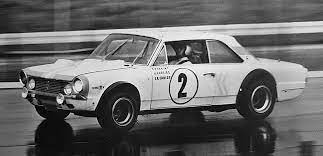
Besides the lack of international experience of the Argentinians, something else caught the attention of the other teams. The Torinos, with their muscle car appearance, seemed to be an unfair adversary against the diminutive European sports cars that dominated the field. Rumour has it that Fangio influenced the directors to create the Above 3000cc class to accommodate the Argentinian vehicles that year. A total of 65 cars started the race on August 19th.

Racing under heavy fog, the 3 Torinos had little problem leading the race during the first 6 hours. Gaston Perkins, at the wheel of the #2 Torino, was dictating the pace with an average of 13 minutes per lap @ 125 km/h. Unfortunately, it started raining during the night, and at lap 41, Cupiero lost control of the #2 and crashed it.

After 12 hours, the best Torino was the #3, with Copelo at the wheel, fighting the Fulvias for the lead. At the 16-hour mark, the Lancias were penalized and the Argentinians took a 1-2 lead.
During the night of the second day, the Torino #1 had electrical problems, and with no lights, Di Palma crashed the car. Now, the hopes of the team (and the whole South American continent) were on the surviving vehicle.

After 53 hours, the Torino #3 led the race when Franco had to pull into the pits with a hanging exhaust. Following the rules of the rally, the driver had to perform the repair without the help of the mechanics. He fixed it as best as possible, but the track marshals suspected the car was still making too much noise, above the allowed 83 decibels. Later on, the race director applied a six-lap penalty because of the loud exhaust.
Fangio’s Tango
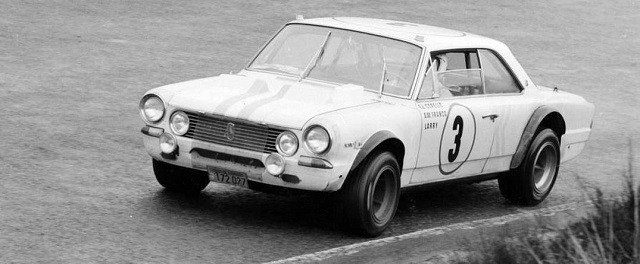
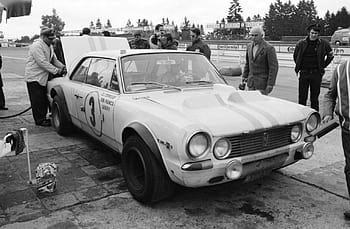
With “only” 20 hours left, Larry pulled the Torino again into the pits to have the brake pads replaced. The poor driver was having difficulty performing the task, and Orestes Berta panicked, shouting instructions to the driver (which was against the rules). One of the track marshals had to intervene, asking Berta to shut up. As the situation was becoming desperate, Fangio had a stroke of brilliance; he started to dance and sing in a loud voice what seemed to be a tango when, in reality, he was singing instructions to his driver. Larry finished the job and rushed back to the race—pure genius.
Within 10 hours left to the end of the race, the #3 was in fifth place overhaul, but a Ford Capri leading the race had to retire with a blown engine, giving one position to the Argentinians.

After 82 hours of blood, sweat, and tears, only 28 cars were still racing. Franco, at the wheel of the surviving Torino, decided to drop the hammer and fight for the P3. Berta and Fangio rushed to the fence and instructed him to slow down to save fuel and the whole car as well. It would be better to finish the race in P4 than not finishing at all.
At the 84-hour mark on August 22, with most of the surviving cars falling apart and the drivers and crew members on the verge of a nervous breakdown, the race finally ended. Oscar Franco had the honour of receiving the checkered flag for the team.
This is the final standing:
First place: Lancia Fulvia, driven by Kallstrom – Barbasio – Fall – 322 laps
Second place: BMW 2002, driven by Duchting – Scheider – Degen – 318 laps
Third place: Triumph TR6, driven by Barbara – Carpentier – Duvachel – 315 laps
Fourth place: IKA Torino 380 W, driven by Copello – “Larry” – Franco – 315 laps
Fifth place: Mazda Cosmo, driven by De Fierlant – Enever – Kelleners – 311 laps
According to the records, the Argentinians finished the race with 334 laps, which would have given them the overhaul victory. Still, the team was penalized for the loud exhaust and for taking a longer than 30-minute pit stop (probably during the brake pads tango episode).
Among the crew, feelings were mixed. They were happy to finish such a gruesome race among the top 5, but at the same time, they were deeply sad for watching some silly technicalities take away the overhaul victory.
Fangio, sensing the frustration in the air, called the team and asked them:
“But tell me one thing, brothers – If you had been told in Argentina that we were going to lead half of the race and that we would finish fourth – Would you have believed?”
And let’s not forget they took home the Above 3-litre trophy, but since no one else was racing in that class, it doesn’t count much.
Upon their return, the team was received as heroes. They proved that the Argentine industry could produce a GT car not only good enough to be among Europe’s finest but also beat them on their own turf.
Final thoughts

Fangio raced during the most dangerous period in the history of Formula One and survived to tell the story of his five world championships. He spent his retirement involved with the one thing he loved the most: motorsports. If this is not a life lived to the fullest, nothing else is. Fangio was inducted into the International Motorsports Hall of Fame in 1990, and he died five years later at his home in Buenos Aires at the age of 84.

Orestes Berta left IKA a couple of years after the race in Nürburgring to dedicate himself to full-time racing. His engineering company, Orestes Berta S.A., became one of the most important centers of motorsport development in South America.
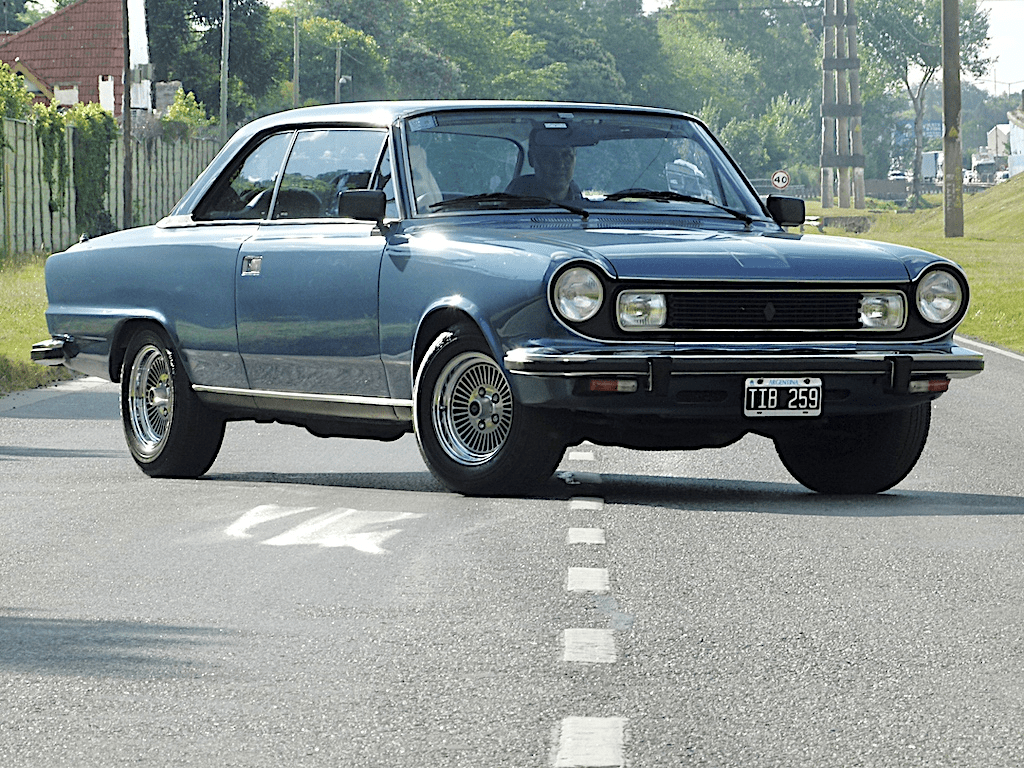
In 1970, Renault assumed control of IKA, but they kept the iconic Torino in production, (pretty much untouched) for as long as they could. The last one left the assembly line in 1982.

As for the three white warriors of 69, they went through an extensive restoration and can often be seen brightening some important automotive events in Argentina. They remind the younger generations what a bunch of inexperienced but passionate gearheads can achieve.
 The Classic Machines
What a fantastic story! Thanks for sharing this! The photos you’ve used are great as well, I really enjoyed reading this post.
LikeLiked by 1 person
Thank you so much, Stuart. I only knew pieces and bits about this epic journey.
The more I researched, the more engaged I became; it was such a fantastic achievement.
LikeLiked by 1 person
That’s amazing. I had not heard of any of that. What a story.
LikeLiked by 1 person
Thanks, Glenn.
This is one of the coolest stories that I have ever come across.
It was a pleasure to research and write about it.
LikeLike
I have a 1/32 scale Torino slot car that I race and it usually wins!!!!!! Go Rambler!
LikeLiked by 1 person
Boy, I love slot cars. You should write an article about your Torino.
LikeLike
This is a great article of this car.
LikeLiked by 1 person
Hello, Gustavo. Thank you for stopping by.
I read the article you sent me, and it is very informative. I also had a good time reading all the comments; it shows how much the Argentinians love the Torino.
LikeLike